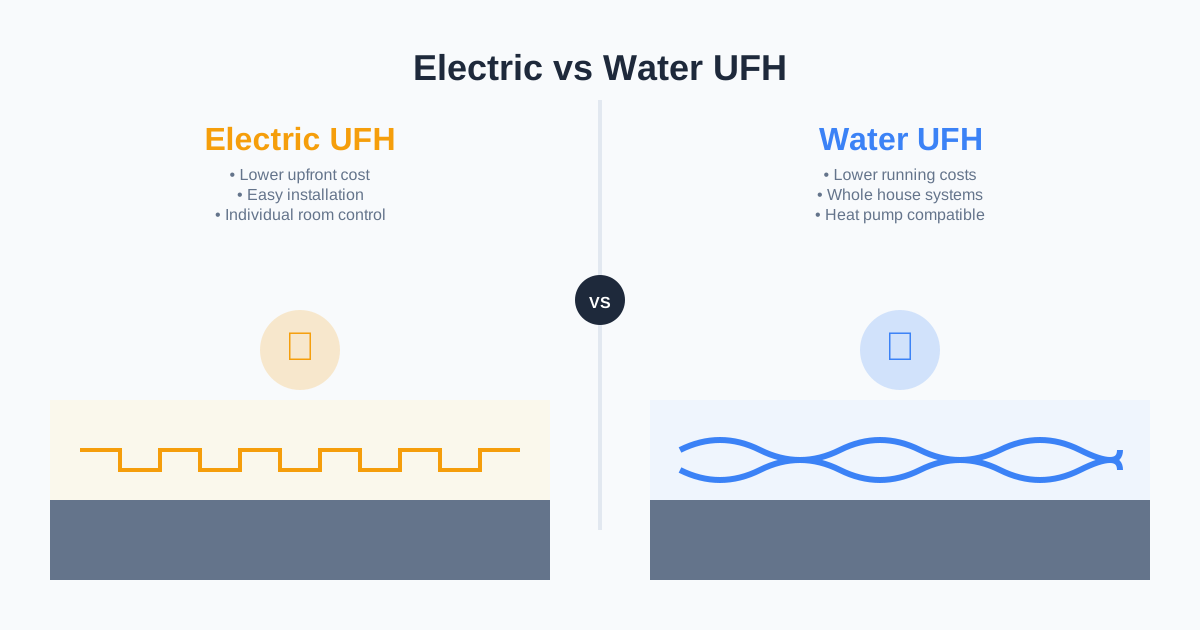
Quick Answer: Electric UFH costs £40–£90/m² installed and heats up in 30-60 minutes, ideal for single rooms, but running costs are £0.55–£0.75/day for a 6m² bathroom. Wet UFH costs £90–£190/m² installed, takes 2-4 hours to heat, but can reduce heating bills in larger spaces over the long term. Choose electric for bathrooms/kitchens; wet for whole-house or with heat pumps.
Electric vs wet underfloor heating: complete comparison guide
When choosing underfloor heating, the biggest decision is whether to install an electric (dry) or water-based (wet) system. Both provide luxurious warmth and eliminate cold floors, but they are suited to very different projects, budgets, and priorities.
This detailed comparison guide examines every aspect: installation costs, running costs, efficiency, installation disruption, heat-up times, and property suitability. By the end, you’ll know exactly which system fits your needs and budget.
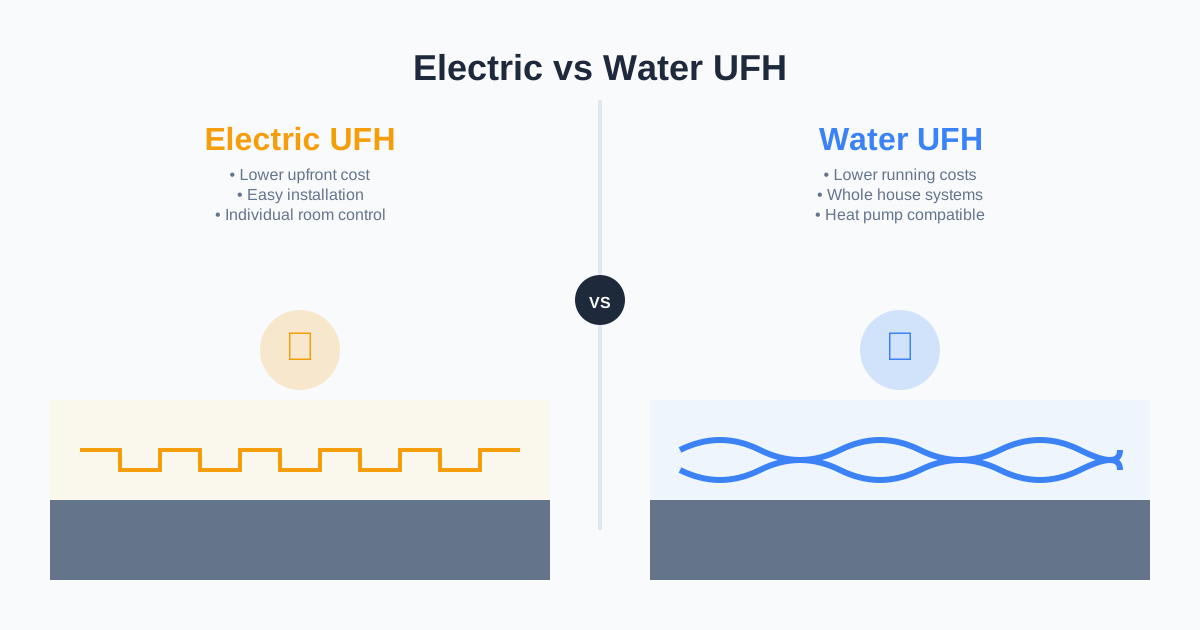
How to use this comparison
This page is the system choice guide. It should help you decide whether electric or wet UFH suits the project.
Use the underfloor heating costs guide when you need full installed prices and quote allowances. Use the running costs guide when you need day-to-day energy calculations. Use the electric underfloor heating systems guide if you have already chosen electric and need to compare mats, loose cable and foil systems.
The simple rule is this: electric wins where access, speed and floor height matter; wet wins where long-term efficiency, heat pumps and larger heated areas matter.
At a glance: key differences
| Feature | Electric UFH | Wet (Water) UFH |
|---|---|---|
| Best For | Single rooms, bathrooms, renovations | Whole-house heating, new builds |
| Installation Cost | £40–£90/m² | £90–£190/m² |
| Running Cost | High (27p/kWh electric) | Low (15-40% less than radiators) |
| Installation Time | 1-2 days | 3-7 days |
| Floor Height Increase | 3-6mm (minimal) | 100-120mm (significant) |
| Heat-up Time | 30-60 minutes | 2-4 hours |
| Lifespan | 25-30+ years | 25-50+ years |
| Maintenance | None | Minimal (annual check) |
| Heat Source | Mains electricity | Boiler or heat pump |
| Disruption | Low | High (major works) |
| DIY-Friendly | Yes (electrician for connections) | No (professional recommended) |
Side-by-side detailed comparison
Installation cost
Electric UFH:
- Materials: £35–£60/m² (heating mats, insulation, thermostat)
- Labour: £15–£30/m² (mat laying, electrical connection)
- Total installed: £40–£90/m²
- Example: 6m² bathroom = £240–£540 (total installed cost)
Wet UFH:
- Materials: £50–£90/m² (pipe, manifold, insulation, screed)
- Labour: £40–£100/m² (pipe laying, manifold setup, pressure testing, commissioning)
- Total installed: £90–£190/m²
- Example: 30m² living room = £2,700–£5,700 (total installed cost)
Winner for upfront cost: Electric UFH (40-60% cheaper to install)
For detailed cost breakdowns including materials, labour, and regional variations, see our Underfloor Heating Costs Guide.
Running cost: the key difference
Running costs are where wet systems demonstrate their superiority for larger installations.
Electric UFH Running Costs:
Electric UFH uses direct electrical heating at 150-200W/m² when operating.
Example 1: Small Bathroom (6m²)
- Power consumption: 6m² × 150W/m² = 900W = 0.9kW
- Usage: 2 hours/day (morning warm-up)
- Daily energy: 0.9kW × 2 hours = 1.8kWh
- Daily cost: 1.8kWh × £0.27/kWh = £0.49/day
- Annual cost: £0.49 × 180 days = £88/year
Example 2: Medium Kitchen (15m²)
- Power consumption: 15m² × 150W/m² = 2,250W = 2.25kW
- Usage: 4 hours/day
- Daily energy: 2.25kW × 4 hours = 9kWh
- Daily cost: 9kWh × £0.27 = £2.43/day
- Annual cost: £2.43 × 240 days = £583/year
Wet UFH Running Costs:
Wet systems use gas (5-7p/kWh) or heat pumps (effectively 8-10p/kWh with COP 3.0) for significantly lower running costs.
Example 3: Large Living Room (30m²) with Gas Boiler
- Heat requirement: 30m² × 80W/m² = 2,400W = 2.4kW
- Usage: 10 hours/day
- Daily energy: 2.4kW × 10 hours = 24kWh
- Daily cost (gas at 6.9p/kWh): 24kWh × £0.069 = £1.66/day
- Annual cost: £1.66 × 240 days = £397/year
Example 4: Same Living Room with Heat Pump
- Heat requirement: 2.4kW ÷ COP 3.2 = 0.75kW electrical input
- Daily energy: 0.75kW × 10 hours = 7.5kWh
- Daily cost: 7.5kWh × £0.27 = £2.03/day
- Annual cost: £2.03 × 240 days = £487/year
Cost Comparison Summary:
| Room Type | Electric UFH Annual Cost | Wet UFH Annual Cost (Gas) | Savings with Wet |
|---|---|---|---|
| 6m² bathroom (2hrs/day) | £88 | £61 | £27 (31%) |
| 15m² kitchen (4hrs/day) | £583 | £238 | £345 (59%) |
| 30m² living room (10hrs/day) | £1,166 | £397 | £769 (66%) |
Winner for running costs: Wet UFH (often cheaper for larger, frequently heated areas)
Want current 2026 tariffs and room-by-room running cost examples? Read our latest underfloor heating running costs guide.
Heat-up time
Electric UFH:
- 30-60 minutes to reach comfortable floor temperature
- Thin screed and low thermal mass = fast response
- Ideal for intermittent use (morning bathroom warm-up)
- Can be turned on 30 minutes before needed
Wet UFH:
- 2-4 hours initial heat-up from cold
- 1-2 hours for subsequent heating cycles
- High thermal mass (screed) retains heat longer
- Best run continuously or with programmable setback temperatures
- Not suitable for rapid on-demand heating
Winner for heat-up time: Electric UFH (4-8× faster response)
Installation complexity and disruption
Electric UFH:
- Installation time: 1-2 days for typical room
- Process: Remove flooring → lay insulation → roll out mats → electrician connects → apply screed/adhesive → wait cure time → lay final floor
- Disruption: Moderate (room out of use for 3-7 days depending on screed cure)
- DIY-friendly: Yes (physical installation is straightforward; electrician required for final connections under Part P)
- Skills required: Basic DIY, measuring, careful following of instructions
Wet UFH:
- Installation time: 3-7 days for typical room
- Process: Remove flooring → lay insulation → fix pipe rails → lay pipes (200-300m for average room) → pressure test → screed → wait 7-21+ days cure → lay final floor
- Disruption: Significant (room out of use for 2-4+ weeks)
- DIY-friendly: Possible but challenging (pipe laying is laborious; pressure testing and commissioning require expertise)
- Skills required: Intermediate plumbing, manifold setup, pressure testing, system balancing
Winner for simplicity: Electric UFH (easier, faster, less disruptive)
Floor height increase
Electric UFH:
- Heating mat: 2-4mm
- Screed/adhesive: 10-15mm
- Total: 12-19mm typical
- Minimal impact on door heights, stairs, floor transitions
- Ideal for retrofits in existing properties
Wet UFH:
- Insulation: 25-100mm
- Pipe: 16-20mm diameter
- Screed: 65-75mm minimum over pipes
- Total: 100-195mm typical
- Significant impact — requires door height adjustments, stair modifications, floor transitions
Low-profile wet options available: Overlay boards reduce to 20-30mm total but are more expensive (£30-50/m²).
Winner for floor height: Electric UFH (6-10× thinner)
For retrofit-specific solutions and low-profile systems, see our Retrofitting Underfloor Heating Guide.
Efficiency and environmental impact
Electric UFH:
- Direct conversion: 1kWh electricity → 1kWh heat (100% efficient at point of use)
- However, electricity generation is only ~40% efficient overall
- Carbon intensity: ~0.23 kg CO₂/kWh (UK grid 2025, decreasing yearly)
- Higher carbon footprint than gas or heat pump systems currently
Wet UFH:
- Gas boiler: 85-92% efficiency (condensing boiler)
- Heat pump: 300-350% efficiency (COP 3.0-3.5) — outputs 3-3.5kWh heat per 1kWh electricity
- Lower flow temperatures (35-45°C) vs radiators (60-75°C) = higher boiler/heat pump efficiency
- 15-25% more efficient than radiator systems
- Heat pump + wet UFH = lowest carbon footprint option
Winner for efficiency: Wet UFH, especially with heat pumps (higher COP at low flow temps)
The heat pump angle: why wet UFH wins
Heat pumps operate most efficiently at low flow temperatures. This is where wet UFH truly excels.
Heat Pump Efficiency (COP) by Flow Temperature:
| Flow Temperature | Heat Pump COP | Efficiency |
|---|---|---|
| 35°C (wet UFH ideal) | 3.5-4.0 | Excellent |
| 45°C (wet UFH acceptable) | 3.0-3.5 | Good |
| 55°C (radiators in older homes) | 2.0-2.5 | Acceptable |
| 65°C (traditional radiator spec) | 1.5-2.0 | Poor |
At 35°C flow temperature:
- 1kWh of electricity → 3.5kWh of heat (COP 3.5)
- Running cost: £0.27/kWh ÷ 3.5 = 7.7p per kWh of heat
- Cheaper than gas (6-7p/kWh) once COP exceeds 4.0
Conclusion: If you’re installing or considering a heat pump, wet UFH is the ideal partner. Electric UFH with a heat pump makes no sense — you’d bypass the heat pump’s efficiency benefits.
For detailed heat pump and UFH system design, see our Underfloor Heating with Heat Pumps Guide.
Electric underfloor heating: detailed look
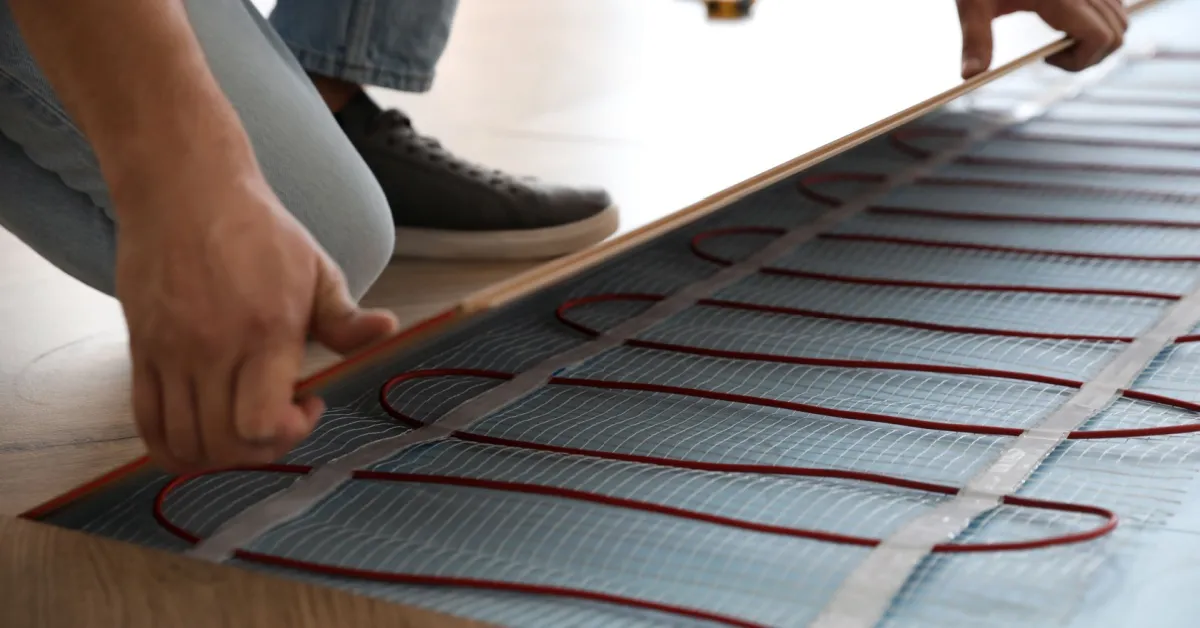
Electric systems are basically a network of heating cables installed under your floor. They are simple, effective, and quick to install.
How electric UFH works
Electrical resistance cables (similar principle to electric kettle elements) convert electricity directly into heat. The cables are either:
- Pre-spaced on mesh mats (most popular, easy installation)
- Loose cables on reels (flexible for awkward shapes)
- Foil systems (ultra-thin for floating floors)
A thermostat controls when the system operates, maintaining target floor or room temperature.
Typical wattage choices:
- Bathrooms: 150 W/m² is common
- Conservatories / high heat loss: up to 200 W/m²
- Low‑profile mats: often 100–150 W/m²
Advantages of electric UFH
Lower Upfront Cost: 40-60% cheaper to install than wet systems Easy Installation: DIY-friendly; mats roll out like carpet Minimal Floor Build-up: Only 12-19mm total height increase Fast Heat-Up Time: Warm in 30-60 minutes, ideal for short usage No Maintenance: No moving parts, no servicing required Long Lifespan: 25-30+ years with detailed warranties Perfect for Single Rooms: Add luxury to bathroom without altering whole heating system Works Anywhere: No need for boiler/manifold; any property with electricity
Disadvantages of electric UFH
Higher Running Costs: Electricity at 27p/kWh vs gas at ~6.9p/kWh Expensive for Large Areas: £500+ annual running cost for whole-house heating Higher Carbon Footprint: Direct electric heating (currently) more carbon-intensive than gas or heat pumps Not Heat Pump Compatible: Bypasses heat pump efficiency gains
When to choose electric UFH
Ideal scenarios:
- Single bathroom renovation (4-8m²)
- Kitchen or ensuite (10-15m²)
- Small extension where wet system impractical
- Retrofit where floor height strictly limited (<20mm available)
- Budget under £1,500 for project
- Rented property (less invasive installation)
- Quick project timeline (complete in 1 week)
Learn more about electric underfloor heating systems →
Wet underfloor heating: detailed look
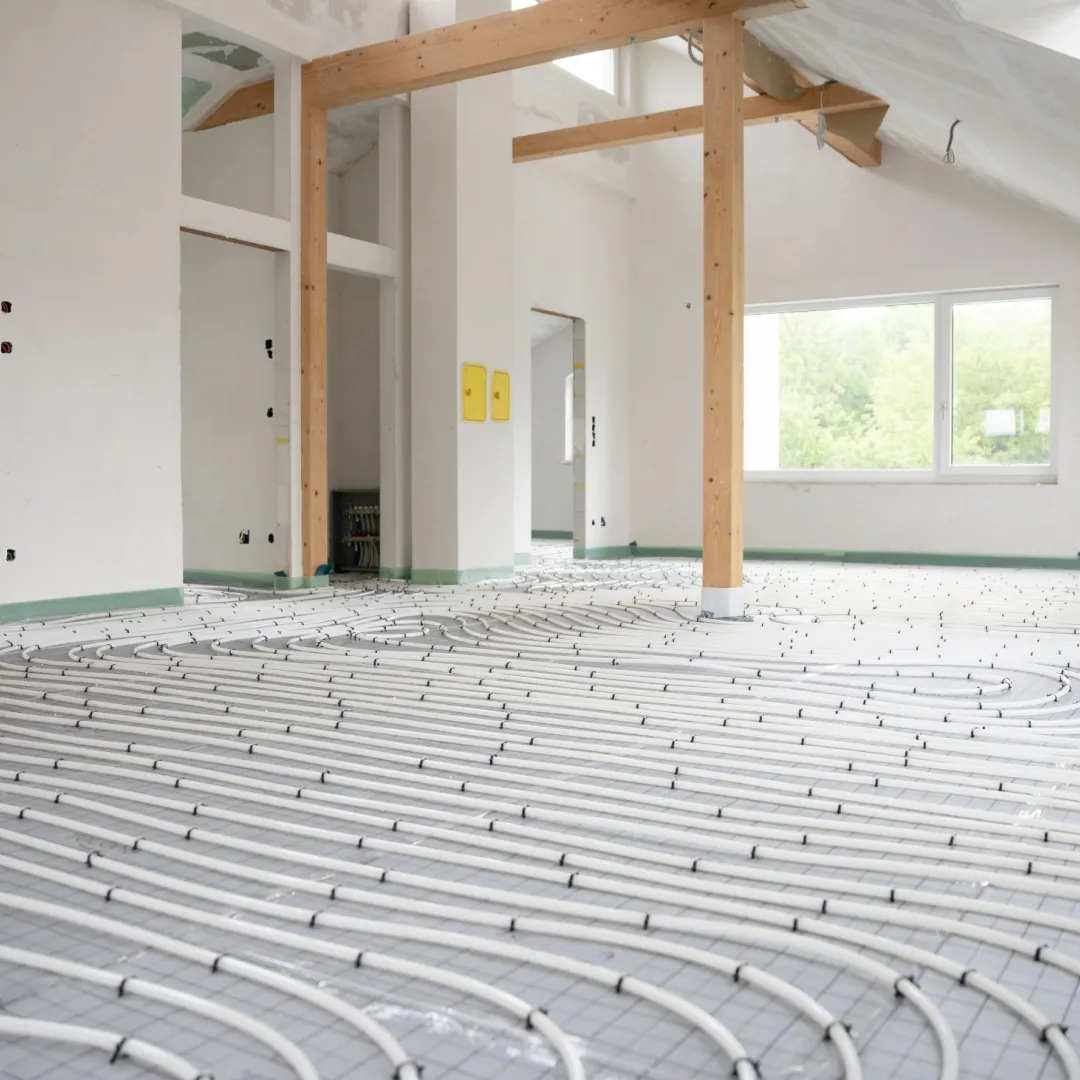
Wet systems pump warm water from your central heating system (boiler or heat pump) through pipes laid in the floor. They are the pinnacle of efficiency for whole-home heating.
How wet UFH works
A network of continuous plastic pipes (typically 16mm PEX) loops back and forth across the floor at 100-300mm spacing. Warm water (35-45°C) circulates through the pipes, heating the floor surface which radiates warmth into the room.
A manifold controls water flow to each zone (room or area), with individual thermostats providing room-by-room temperature control.
Advantages of wet UFH
Lower Running Costs: 15-40% more efficient than radiators; 50-70% cheaper than electric UFH Perfect for Whole-House Heating: Most cost-effective for 3+ rooms or entire floors Works with Renewable Energy: Ideal partner for air source (ASHP) or ground source (GSHP) heat pumps Maximum Efficiency: Low flow temperatures (35-45°C) maximise boiler/heat pump COP Increases Property Value: Desirable feature for modern homes; appeals to buyers Even Heat Distribution: No cold spots; uniform warmth across entire floor Long Lifespan: 25-50+ years; pipes embedded in screed rarely fail
Disadvantages of wet UFH
Higher Installation Costs: £90-190/m² vs £40-90/m² for electric Complex Installation: Requires manifold, pump, pipework, professional commissioning Significant Disruption: Room out of use for 2-4+ weeks during installation Floor Build-up: 100-195mm typical (significant impact on door heights, stairs) Slower Response Time: 2-4 hours heat-up; not suitable for rapid on-demand heating Professional Installation Recommended: Not beginner DIY-friendly
When to choose wet UFH
Ideal scenarios:
- New build (entire house, 80-150m²+)
- Major renovation where floors already being replaced
- Open-plan living areas (30-60m²)
- Whole-house heating project (3+ rooms)
- Installing or already have heat pump
- Budget over £5,000 for project
- Priority is long-term efficiency and low running costs
- Property has sufficient floor height clearance (100mm+)
Learn more about wet underfloor heating systems →
Property type guide: which system suits your home?
New Build
Recommendation: Wet UFH
Why:
- Floors already being installed (no disruption)
- Floor height can be designed-in from start
- Future Building Regulations will likely require heat pumps (wet UFH ideal partner)
- Lowest lifetime running costs
- Adds value and desirability
Cost for 100m² house: £9,000–£15,000 installed
Retrofit: single room (bathroom/kitchen)
Recommendation: Electric UFH
Why:
- Minimal disruption (1-2 days vs 1-2 weeks)
- Low floor height increase (fits under existing door heights)
- Cost-effective for small area (£300-800 total)
- Fast installation (room back in use quickly)
- Running costs acceptable for intermittent use (bathrooms heated 2-4 hrs/day)
Cost for 6m² bathroom: £300–£700 installed
Retrofit: multiple rooms or whole house
Recommendation: Wet UFH
Why:
- Running cost savings justify higher installation cost within 3-7 years
- Can be done room-by-room over time to spread cost
- Much cheaper to run for all-day heating
- Works with heat pump for future-proofing
Alternative: Low-profile wet UFH systems (like Wunda) if floor height restricted
Cost for 50m² ground floor: £4,500–£9,500 installed
Period property / listed building
Recommendation: Electric UFH
Why:
- Minimal floor height increase preserves original floor levels
- Less invasive installation (important for conservation areas)
- Doesn’t require manifold/pipework routing through period features
- Can be installed without structural alterations
Alternative: Suspended wet UFH systems if accessible void below
Extension or Conservatory
Recommendation: Wet UFH (if new build) or Electric UFH (if retrofit)
Why (wet for new build):
- Can connect to existing heating system
- High heat loss areas (lots of glass) benefit from wet system efficiency
Why (electric for retrofit):
- Isolated from main heating system
- Lower installation cost for single room
- Fast installation minimises disruption
Decision flow: which system to choose?
Use this decision flow to pick the right system:
- Project scope: single small room (bathroom/ensuite/small kitchen 4–10m²) → electric. Multiple rooms or whole house (3+ rooms, 40m²+) → wet.
- Budget: under £2,000 → electric. Over £5,000 → wet. £2,000–£5,000 → depends on area.
- Floor situation: height limited (<50mm) → electric. New build or major renovation → wet. Retrofit with existing floors → check build‑up carefully.
- Usage pattern: intermittent (bathroom 1–2hrs, kitchen 2–4hrs/day) → electric. All‑day heating → wet.
- Heat pump plans: yes or planned → wet. No → either system, depending on area.
- Timeline: need it in a week → electric. Can allow 2–4+ weeks → wet.
The grey area: when either system could work
Some projects genuinely sit in the middle. A 12-18m² kitchen, utility room or extension may be suitable for either electric or wet UFH depending on use.
Choose electric if the room is used for short comfort boosts, floor height is tight, and the existing heating already covers the main heat load. Choose wet if the room is occupied for long periods, the floor is already being rebuilt, or you may move to a heat pump later.
This is where insulation and controls decide the outcome. Good insulation and a smart thermostat can make electric UFH acceptable in a small kitchen. Poor insulation and high flow temperatures can make wet UFH underperform, even though it is theoretically the more efficient system.
Cost of switching: electric to wet upgrade
If you’ve installed electric UFH and later wish you’d chosen wet, switching is possible but expensive:
What’s involved:
- Remove floor covering
- Remove screed/adhesive to expose electric cables
- Remove electric system (may be damaged in removal; usually discarded)
- Install wet system (insulation, pipes, screed)
- Replace floor covering
Cost: £90-190/m² for wet installation + £20-40/m² removal/disposal + new floor covering
Total: Similar to new wet installation (£110-230/m²) — you basically pay twice
Conclusion: Choose carefully first time; switching systems is rarely cost-effective
Common mistakes to avoid
Mistake 1: choosing electric for whole-house primary heating
Why it’s a mistake: Running costs of £1,500-3,000/year for average house (vs £600-1,200 for wet system with gas/heat pump)
Better approach: Use wet UFH for whole-house; electric for isolated rooms not worth connecting to wet system
Mistake 2: installing wet UFH in a single small bathroom
Why it’s a mistake: Installation cost £800-1,500 vs £300-700 for electric; running cost savings only £20-40/year = 15-30 year payback
Better approach: Electric UFH for bathrooms <10m² used intermittently
Mistake 3: not considering heat pump future
Why it’s a mistake: Installing electric UFH now means missing out on heat pump efficiency gains if/when you upgrade
Better approach: If considering heat pump within 5-10 years, install wet UFH now (even if using gas boiler initially)
Mistake 4: skipping professional design for wet systems
Why it’s a mistake: Incorrect pipe spacing, zoning, or manifold sizing leads to cold rooms, inefficiency, or system failure
Better approach: Pay £200-500 for professional heat loss calculation and system design; saves £1,000s in mistakes
For design guidance and avoiding common pitfalls, see our Underfloor Heating Design & Planning Guide.
Frequently asked questions
1. Is electric or water underfloor heating cheaper to run?
Wet (water) UFH is usually cheaper to run than electric in larger spaces. A 30m² living room costs approximately £397/year with wet UFH (gas) vs £1,166/year with electric UFH. For small bathrooms used intermittently, the difference is smaller (£61 vs £88/year). Wet systems use gas at ~6.9p/kWh or heat pumps at effective 8-10p/kWh, compared to electricity at 27p/kWh for electric systems.
2. Which is better for a bathroom: electric or wet underfloor heating?
Electric UFH is better for most bathrooms due to lower installation cost (£300-700 vs £800-1,500), minimal floor height increase (12-19mm vs 100-120mm), faster installation (1-2 days vs 2-3 weeks), and acceptable running costs for intermittent use (£88/year for 2hrs daily). Wet UFH only makes sense for bathrooms if you’re already installing it throughout the house.
3. Can you have both electric and wet underfloor heating in the same house?
Yes, mixing systems is common and sensible. Typical approach: wet UFH for main living areas (living room, open-plan kitchen-diner) connected to central heating; electric UFH for isolated rooms (upstairs bathroom, ensuite) not worth connecting to wet manifold. This combines efficiency where it matters most with convenience and lower installation cost for small isolated areas.
4. How much does it cost to run electric underfloor heating vs wet?
Running cost comparison at 2026 UK energy prices:
- 6m² bathroom (2hrs/day): Electric £88/year, Wet (gas) £61/year
- 15m² kitchen (4hrs/day): Electric £583/year, Wet (gas) £238/year
- 30m² living room (10hrs/day): Electric £1,166/year, Wet (gas) £397/year
Electric is 30-65% more expensive depending on usage. The larger the area and longer the usage, the bigger the savings with wet UFH.
5. Which heats up faster: electric or wet underfloor heating?
Electric UFH heats up much faster — 30-60 minutes to comfortable floor temperature vs 2-4 hours for wet systems. Electric systems have low thermal mass (thin screed), while wet systems have high thermal mass (thick screed retains heat longer but takes longer to warm up). For on-demand heating (bathroom warm-up before shower), electric is superior. For all-day heating, wet’s thermal mass is actually beneficial (retains warmth after system turns off).
6. Is wet underfloor heating worth the extra cost?
Yes, if heating large areas (30m²+) or whole house. Initial installation costs £90-190/m² vs £40-90/m² for electric, but running cost savings of £300-800/year for typical home means payback can be in the mid‑term for larger areas (varies by tariff and usage). Over a 25-year system lifespan, wet UFH saves £7,500-20,000+ in energy costs. For single small rooms (<10m²), electric is more cost-effective.
7. Can electric underfloor heating be used as the main heating source?
Technically yes, but not recommended for UK homes due to high running costs. A 100m² house would cost £1,800-3,200/year to heat with electric UFH vs £600-900/year with wet UFH and gas boiler, or £800-1,200/year with wet UFH and heat pump. Electric UFH works best as supplementary heating for comfort in specific rooms (bathrooms, kitchens) while radiators or wet UFH handle primary heating.
8. Does underfloor heating work with heat pumps?
Wet UFH works brilliantly with heat pumps — it’s the ideal pairing. UFH operates efficiently at 35-45°C flow temperature where heat pumps achieve COP 3.0-3.5 (300-350% efficiency). Radiators require 55-65°C, reducing heat pump COP to 2.0-2.5. Electric UFH with heat pumps makes no sense — you’d be using expensive direct electric heating and bypassing the heat pump entirely. If you have a heat pump, always choose wet UFH.
Conclusion: making the right choice
The electric vs wet decision depends on your specific project, budget, and priorities:
Choose Electric UFH if:
- Single room project (bathroom, kitchen, ensuite)
- Budget under £1,500
- Floor height severely limited (<20mm available)
- Quick installation needed (1-2 days)
- Intermittent usage (2-4 hours/day)
- DIY installation preferred
Choose Wet UFH if:
- Whole-house heating (3+ rooms)
- Budget over £5,000
- New build or major renovation
- Installing or have heat pump
- All-day heating required
- Priority is long-term efficiency and low running costs
Hybrid approach (often best): Many homeowners benefit from combining both systems: wet UFH for main living areas where running cost savings justify installation expense, and electric UFH for isolated rooms (upstairs bathrooms) where connection to wet system would be impractical or expensive.
Return on investment:
- Electric UFH for bathroom: Pays for itself through comfort and property value boost
- Wet UFH for whole house: Pays for itself through energy savings in 3-7 years; can save money over the long term depending on tariffs and usage
The right choice delivers decades of comfort, efficiency, and value. The wrong choice leads to regret, high running costs, or expensive system replacement.
For detailed cost breakdowns, ROI calculations, and help choosing between electric and wet systems based on your specific situation, check our Complete Costs Guide.
For detailed installation guidance once you’ve made your decision, see our Underfloor Heating Installation Guide.
Flooring considerations for both systems
Your choice of flooring affects both electric and wet UFH performance. Tiles deliver the highest heat output (71 W/m²) but feel cold when the system is off. Engineered wood provides 56 W/m², with a warmer feel but requires careful temperature monitoring (27°C maximum). Your flooring choice can impact running costs by up to 48%. For detailed comparisons and room-specific recommendations, see our best flooring for underfloor heating guide.
Choosing a reputable brand
Whichever system type you choose, selecting a reliable manufacturer is important for long-term performance and warranty support. Quality brands provide better installation support, more detailed warranties, and superior customer service. For expert reviews and comparisons of the top UFH manufacturers in the UK, including Warmup, ProWarm, Uponor, and more, see our Best Underfloor Heating Brands Guide.
Ready to get started?
Once you’ve decided on the right system for your home, the next step is getting accurate quotes from qualified installers. Professional installation ensures your system performs optimally and maintains warranty coverage. For guidance on getting competitive quotes and what to expect from the quotation process, see our underfloor heating quotation guide.
Still undecided? Our Ultimate Beginner’s Guide to Underfloor Heating provides even more detail to help you make the right choice.
One useful email,
once a month.
New guides as they go live. Real cost data, not press releases. The occasional rumour from the industry that's actually worth knowing.
No sales pitches. No jargon. Unsubscribe in one click.