Draft outline (scope, when it applies, and compliance checklists)
Use underfloorheating.info for practical UK guidance and the Underfloor Heating Directory when you are ready to find an installer for a compliant project.
- Scope: What Part L and Part P cover, how BS EN 1264 fits in, and where MCS guidance applies (especially for heat pump-driven systems).
- When it applies: New builds, extensions, material changes, renovations, and any new electrical circuits or controls.
- Compliance by system type: Separate checklists for electric and wet (hydronic) underfloor heating.
- Certification and handover: What installers must certify, test results, and homeowner documentation.
- Practical flowchart: A plain-English route from design to sign-off.
UK Building Regulations for Underfloor Heating: A practical compliance guide
If you are planning underfloor heating (UFH) in the UK, building regulations are not a box-ticking exercise. They determine how the system must be designed, installed, tested, and certified. They also influence what evidence you need for Building Control, mortgage providers, and warranties.
This guide summarises what the regulations cover, when they apply, and how compliance differs between electric and wet (hydronic) systems. It is written for homeowners, self-builders, and installers who want clarity rather than jargon.
The three compliance pillars in plain English
1) Part L: Energy efficiency
Part L of the Building Regulations sets energy efficiency requirements for new builds and renovations. It is published as Approved Document L in England and Wales on the government site, and it focuses on fabric performance, heating controls, and system efficiency. For UFH, Part L affects insulation, heat loss calculations, heat source efficiency, and controls such as zoning and time/temperature programming.
Reference: Approved Document L (Conservation of fuel and power)
2) Part P: Electrical safety
Part P is the electrical safety section of the Building Regulations. It applies to any fixed electrical installation work, including electric UFH mats, cables, thermostats, and new circuits. Notifiable work must be carried out by a registered electrician or notified to Building Control.
Reference: Approved Document P (Electrical safety)
Note: Building regulations are devolved. Scotland uses Building Standards (Section 6 for energy), and Northern Ireland uses Technical Booklets. Always confirm the local requirements with your Building Control body.
3) BS EN 1264: Design and performance standard for wet UFH
BS EN 1264 is the European standard that defines how water-based surface embedded heating and cooling systems are designed, tested, and commissioned. It is not law, but it is the recognised technical benchmark for wet UFH design, output calculations, and testing. Many manufacturers, designers, and warranty providers expect systems to follow BS EN 1264 principles.
Reference: BS EN 1264 overview (BSI)
Where MCS guidance fits in
MCS (Microgeneration Certification Scheme) guidance is most relevant if the wet UFH system is paired with a heat pump or is part of a renewable heating installation. MCS standards and installation guidance govern the design, commissioning, and paperwork needed for eligibility under schemes such as the Boiler Upgrade Scheme.
Reference: MCS standards and guidance
When building regulations apply to UFH
In practice, building regulations apply in the following situations:
- New builds and major renovations: Full Part L compliance is required, including insulation, heat loss calculations, and high-efficiency controls.
- Extensions and conversions: The new area must meet current standards, and any new heating controls must comply with Part L.
- Material alterations: Replacing or upgrading heating systems, adding new zones, or changing the heat source can trigger Part L compliance checks.
- Any new electrical circuit or fixed wiring: Electric UFH and new thermostats fall under Part P rules for electrical safety.
If you are unsure whether work is notifiable, ask Building Control early. It is far easier to document compliance during design and installation than to fix it after the floor goes down.
Compliance checklist: electric vs wet systems
This is the practical checklist you can use on site or during specification.
| Requirement | Electric UFH | Wet (hydronic) UFH |
|---|---|---|
| Part L energy efficiency | Confirm insulation levels, design heat output, and programmable controls | Heat loss calculations, flow temperatures, zoning, and insulated pipework |
| Part P electrical safety | New circuits and thermostats must be installed and certified | Electrical elements (wiring centre, actuators, pumps) still need Part P compliance |
| BS EN 1264 alignment | Not typically applied | Design, output calculations, circuit lengths, and testing should follow BS EN 1264 |
| Controls and zoning | Programmable thermostat, floor sensor, suitable load rating | Room-by-room zoning, mixing controls, and temperature limits |
| Commissioning and tests | Electrical tests (continuity, insulation resistance) | Pressure test, flushing, balancing, and commissioning records |
| Handover documentation | Electrical Installation Certificate (EIC) and Part P notification | Commissioning sheet, as-built layout, pressure test results, and controls setup |
For installation best practice, see our DIY UFH Installation Guide and if you are gathering quotes, read our Underfloor Heating Quotation Guide.
If you are comparing trades, use the underfloor heating installer qualifications checklist to verify the right electrician, heating engineer, Gas Safe, or MCS credentials for the work involved.
Compliance flowchart (from design to sign-off)
START
  |
  |-- 1) Does the work trigger Building Regs?
  |       |-- New build / extension / conversion -> Part L applies
  |       |-- Alteration or new circuit -> Part L or Part P may apply
  |
  |-- 2) Choose system type
  |       |-- Electric UFH -> Part P for fixed wiring + test certification
  |       |-- Wet UFH      -> BS EN 1264 design principles
  |
  |-- 3) Design & specification
  |       |-- Heat loss calculation and room outputs
  |       |-- Floor insulation and build-up confirmed
  |       |-- Controls and zoning schedule defined
  |
  |-- 4) Install & test
  |       |-- Electric: mat/cable layout + resistance/insulation tests
  |       |-- Wet: pipe layout + pressure test + manifold setup
  |
  |-- 5) Commission
  |       |-- Balance circuits, set controls, verify temperatures
  |       |-- Record results and as-built drawings
  |
  |-- 6) Certify & hand over
  |       |-- Part P cert (if applicable) + Building Control sign-off
  |       |-- Handover pack: test results, warranties, controls guide
  |
FINISH
Exceptions to building regulation certificates: when a separate certificate may not be issued
Many homeowners search for exceptions to building regulation certificate rules. In UFH projects, the confusion usually comes from how work is notified rather than from a true exemption.
In plain terms, a separate Building Control certificate may not be issued when:
- Work is non-notifiable: Minor electrical alterations that are not notifiable under Part P may not generate a separate compliance certificate.
- A registered installer self-certifies: If the installer belongs to a competent person scheme, they submit compliance directly and you may receive scheme paperwork instead of a standalone local authority certificate.
- UFH is part of broader approved works: Evidence can appear in the wider project completion documents rather than as a UFH-only certificate.
What does not change: safety testing, commissioning records, and compliance evidence are still required. Keep all documents (electrical certificates, commissioning sheets, and warranties) because solicitors and surveyors often request them during sale or remortgage.
What installers must certify and hand over
This is the documentation that should be provided at completion. If you are a homeowner, insist on this; if you are an installer, build it into your handover pack.
For electric underfloor heating
- Electrical Installation Certificate (EIC) or Minor Electrical Installation Works Certificate, depending on the scope.
- Part P compliance notification or Building Control certificate if the work is notifiable.
- Manufacturer warranty registration with recorded test readings (resistance, insulation).
- Controls setup and user instructions.
For wet (hydronic) underfloor heating
- Pressure test record (including test pressure and duration).
- Commissioning sheet with flow rates, manifold settings, and actuator checks.
- As-built layout drawings showing pipe runs, manifold location, and sensor position.
- Heat loss calculation summary (room-by-room output design).
- Controls configuration and user instructions.
When heat pumps or renewables are involved
If the UFH is tied to a heat pump or a renewable installation, you may also need:
- MCS certificate and handover pack (required for grant eligibility).
- System commissioning checklist aligned with MCS guidance.
Reference: MCS standards and guidance
How Part L changes the design brief
Part L pushes UFH design in a few key directions:
- Lower flow temperatures: Wet UFH is naturally suited to low-temperature heating, which improves boiler efficiency and is essential for heat pump performance.
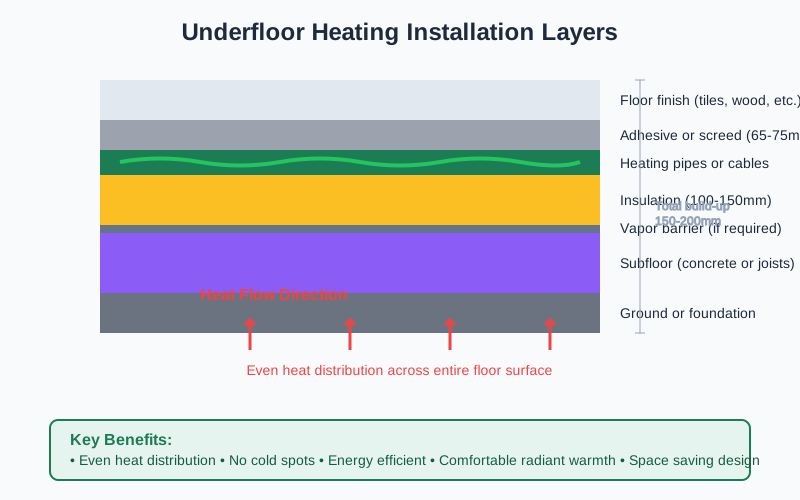
- High levels of insulation: Floor insulation and perimeter insulation are critical. Without them, heat loss increases and Part L compliance becomes harder to achieve.
- Time and temperature controls: Zoning and programmable controls are expected. A single on/off switch for the whole house is no longer sufficient.
- Heat loss calculations: Each room should be sized for output and pipe spacing, not guessed.
The practical result is that UFH becomes a system-wide design task, not just a flooring choice.
How Part P affects electric UFH installations
Electric UFH is often installed in bathrooms and kitchens, which are classed as special locations for electrical work. Part P makes sure the wiring is safe and properly certified. Key points include:
- New circuits are notifiable. If you are adding a new circuit for UFH, it must be installed by a Part P registered electrician or signed off by Building Control.
- Thermostats and sensors count as fixed wiring. Even if the heating mat is DIY, the final connection and testing must be certified.
- Documentation protects warranties. Most manufacturers require certified electrical test results to keep the warranty valid.
If you are unsure what is notifiable, check the Approved Document P guidance or ask a registered electrician at quotation stage.
BS EN 1264 in practice for wet UFH
BS EN 1264 is the backbone of wet UFH design. The standard covers:
- Design heat output calculations based on floor construction and room heat loss.
- Maximum surface temperatures to avoid discomfort and floor damage.
- Circuit length limits and pipe spacing to maintain even heat distribution.
- Testing and commissioning to prove the system is safe and performs as designed.
Even if you do not purchase the standard, a competent UFH designer should follow its principles. This is especially important where you need warranty support or third-party sign-off.
Typical compliance risks (and how to avoid them)
- Skipping insulation to save money: This is the most common cause of Part L failures and high running costs. Use the correct insulation thickness for the floor type.
- No heat loss calculation: UFH output must match the room demand. Guessing leads to cold rooms and failed compliance checks.
- Uncertified electrical connections: This can invalidate warranties and create safety risks. It also creates delays with Building Control.
- No commissioning records: If the system is not balanced and documented, it is hard to prove compliance or diagnose issues later.
For a cost reality check, see our Underfloor Heating Costs Guide and compare it with the savings from efficient design.
FAQs
Q: Do I need Building Control approval for underfloor heating? A: Often yes. New builds, extensions, and any notifiable electrical work must be signed off. If you use installers registered with a competent person scheme, they can usually self-certify and notify Building Control on your behalf.
Q: Is electric UFH allowed under Part L? A: Yes, but it still needs proper insulation, controls, and energy efficiency measures. Electric UFH can meet Part L in smaller areas or well-insulated spaces, but running costs and heat source efficiency will be scrutinised in new builds.
Q: Does BS EN 1264 apply to electric systems? A: No, it applies to water-based (hydronic) surface embedded systems. Electric UFH follows electrical safety rules and manufacturer guidance, plus Part L energy performance requirements.
Q: Can I install UFH myself if I am competent? A: You can lay mats or pipes, but certification matters. Electric systems must be connected and tested by a qualified electrician. Wet systems should be pressure tested and commissioned by a competent installer, with documentation for Building Control.
Q: What are exceptions to building regulation certificates for UFH? A: Most projects still need compliance evidence. The main “exceptions” are usually non-notifiable minor works or competent-person self-certification, where you may not receive a separate local authority certificate. Keep all alternative compliance documents.
Q: What documentation should I keep as a homeowner? A: Keep your Part P certificate, commissioning sheets, test results, as-built drawings, and manufacturer warranties. These are important for resale, insurance, and future maintenance.
Sources and further reading
- Approved Document L: Conservation of fuel and power
- Approved Document P: Electrical safety
- BS EN 1264 overview (BSI)
- MCS standards and guidance
If you are comparing installers, our Underfloor Heating Quotation Guide explains what to ask for in the compliance paperwork, and our DIY UFH Installation Guide shows the practical steps where compliance evidence is typically recorded.
One useful email,
once a month.
New guides as they go live. Real cost data, not press releases. The occasional rumour from the industry that's actually worth knowing.
No sales pitches. No jargon. Unsubscribe in one click.