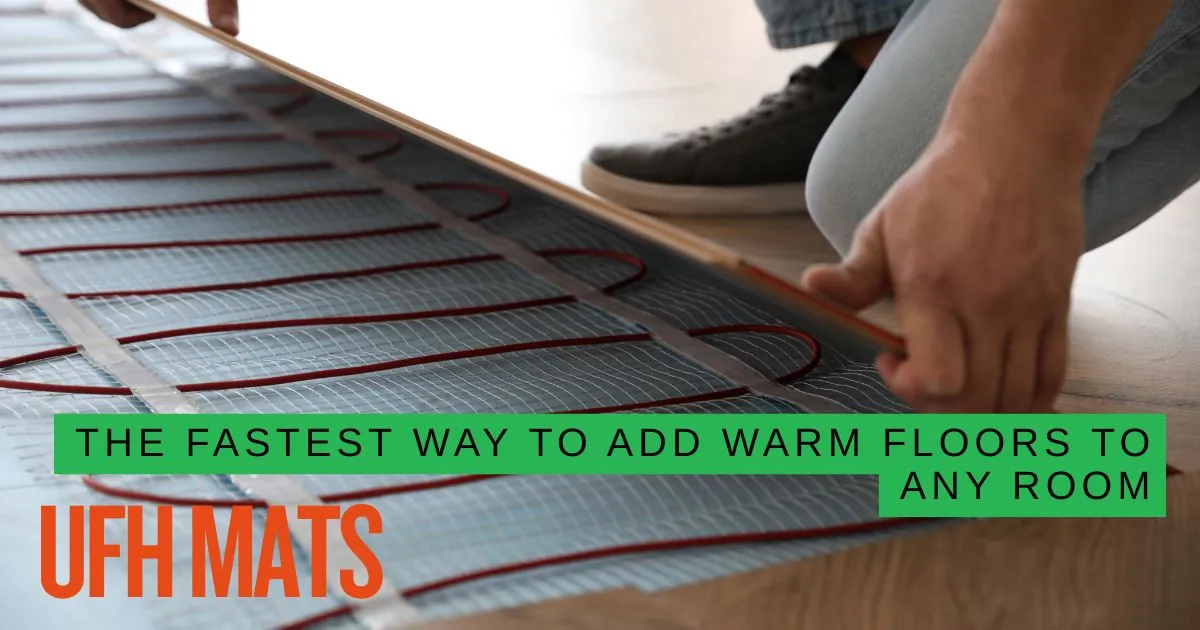
Quick Answer: An underfloor heating mat is a pre-spaced electric heating cable fixed to a mesh or foil backing, the fastest way to add warm floors to any room. Mesh mats embed in tile adhesive for tiled floors. Foil mats lay dry under floating laminate or engineered wood. Loose cable fits irregular shapes. Costs range from £20–£65/m² for materials. A Part P certified electrician must make the final connection. Explore more advice at underfloorheating.info and find project support through the Underfloor Heating Directory.
Guided reading
Not sure where to start?
Answer three quick questions and we will point you to the right guides for your project.
Find your starting pointThree questions. About 30 seconds. No sign-up.
What is an underfloor heating mat?
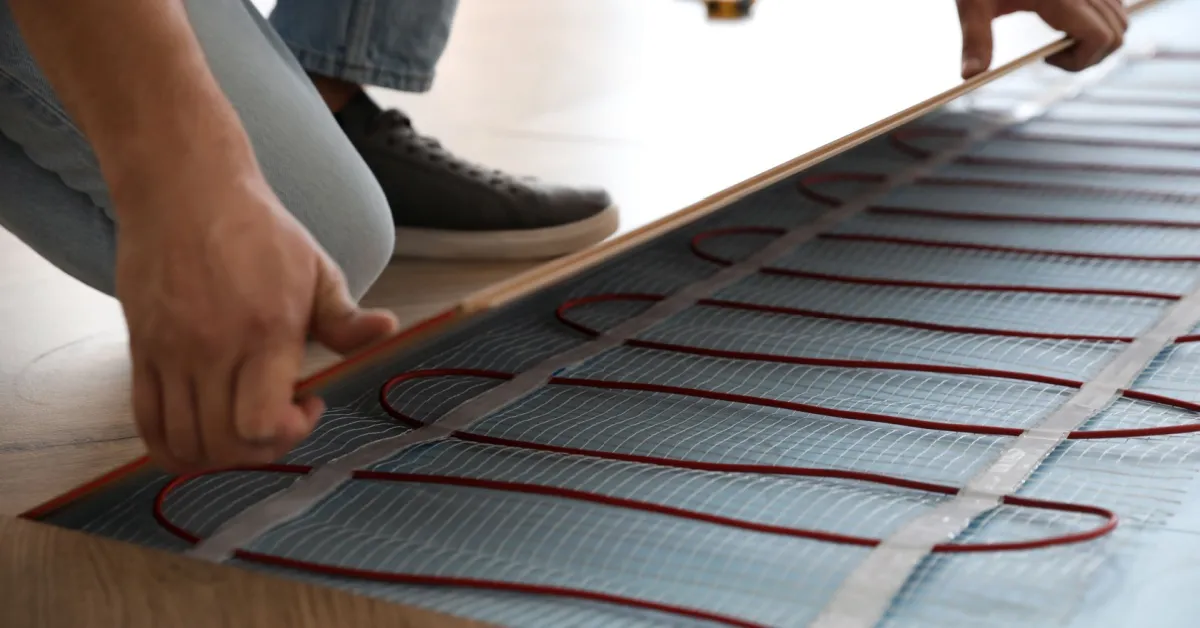
An underfloor heating mat is simply an electric resistance cable fixed to a flexible fibreglass mesh or aluminium foil backing. It arrives pre-spaced and ready to unroll, so you don't have to clip individual cables across the floor. That makes the installation faster and more consistent than a loose cable system.
Mats are the most popular form of electric underfloor heating in the UK, with millions installed in bathrooms, kitchens and ensuites. They sit directly beneath the floor finish, either in tile adhesive, under a thin layer of self-levelling compound or dry-laid beneath a floating floor. A dedicated thermostat controls the temperature.
For a comparison of electric mats versus a full wet (water-based) system, see our Electric vs Water UFH Guide.
The three types of underfloor heating mat
So which mat do you need? There are three formats, and each suits a different floor type and installation method.
1. Mesh heating mats (most popular)
A resistance cable is woven in a continuous serpentine pattern across a fibreglass mesh backing, pre-fixed at a consistent spacing of 65–80mm between runs. The mesh has a self-adhesive backing to stick to the subfloor during installation.
- Profile: 3–6mm (cable + adhesive or SLC)
- Wattage: 150W/m² (standard) or 200W/m² (higher output for colder rooms)
- Best for: Tiles, porcelain, stone, polished concrete, any floor embedded in adhesive or thin screed
- Not suitable for: Floating floors without self-levelling compound
2. Foil heating mats (for floating floors)
A carbon ink heating element is printed between layers of reinforced aluminium foil. These are dry-laid, no adhesive required, directly on the subfloor beneath a floating floor finish.
- Profile: 0.5–3mm (ultra-thin)
- Wattage: Typically 80–130W/m²
- Best for: Laminate, floating engineered wood, LVT/vinyl click floors
- Not suitable for: Wet rooms, tiled floors, or anywhere requiring adhesive embedding
3. Loose cable (most flexible)
A single cable on a reel, fixed with cable clips or spacing strips at your chosen spacing. More time-consuming to install but fits any room shape perfectly, including L-shapes and areas with many obstacles.
- Profile: 2–4mm
- Wattage: 150–200W/m² depending on spacing
- Best for: Irregularly shaped rooms, experienced installers
- Not suitable for: First-time DIY, spacing consistency is critical
| Type | Profile | Wattage | Best floor type | DIY-friendly? |
|---|---|---|---|---|
| Mesh mat | 3–6mm | 150–200W/m² | Tiles, stone, SLC finishes | ✅ Yes |
| Foil mat | 0.5–3mm | 80–130W/m² | Laminate, LVT, floating | ✅ Yes |
| Loose cable | 2–4mm | 150–200W/m² | Any floor (with SLC) | ⚠️ Experienced only |
Which mat for which floor? The complete compatibility guide
The floor finish decides which mat you can use. Get that pairing wrong and you can damage the floor, which is one of the most common installation problems I see. Here's what works with each common UK floor type.
Tiles, porcelain, and stone ✅ Best performance
Use: Mesh mat (150W/m²)
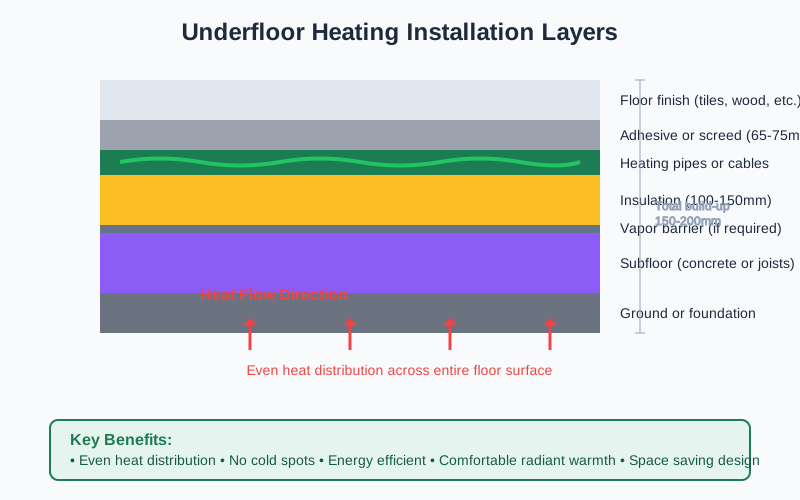
Tiles are the ideal partner for UFH mats. The mesh mat lies on the insulation board and tiles are set directly on top in flexible tile adhesive (3–5mm depth). No screed or self-levelling compound is needed in most cases, the tile adhesive encases and protects the mat while transferring heat efficiently into the dense tile surface.
- Heat-up time: 30–45 minutes
- Efficiency: ★★★★★
- Leave a 50mm gap around the perimeter and skip under bath panels, shower trays, and toilet pedestals
- Use flexible tile adhesive only (standard rigid adhesive can crack due to thermal expansion)
For room-specific guidance, see our Bathroom UFH Guide and Kitchen UFH Guide.
Laminate flooring ⚠️ Foil mat only
Use: Foil mat, not a mesh mat
This is the most frequently misunderstood pairing. A standard mesh mat cannot be embedded in adhesive under a floating laminate floor. Laminate must float freely to expand and contract with temperature; adding a screed or adhesive layer beneath it causes buckling and voids the floor warranty.
The correct solution is a foil mat laid dry directly on the insulation board, with the laminate clicked in place on top. No adhesive. No screed.
Essential checks before purchasing:
- The laminate must be explicitly rated for underfloor heating use
- Maximum floor surface temperature: 27°C
- Maximum combined thermal resistance of laminate plus underlay: 1.5 tog, check the packaging; standard foam underlay typically exceeds this
- Use a UFH-compatible underlay (typically 3mm maximum, with low tog rating)
Engineered wood
Use: Mesh mat (under 10–15mm SLC) or foil mat (if floating installation)
Engineered wood can be glued or floated, and the installation method determines which mat type to use:
- Glued-down: Mesh mat under 10–15mm self-levelling compound. Allow SLC to cure fully before laying.
- Floating: Foil mat, same approach as laminate. Check manufacturer's tog specification.
- Maximum floor temperature: 27°C
- Confirm the product is explicitly UFH-rated, many engineered wood products are not
Vinyl / LVT (Luxury Vinyl Tile)
Use: Foil mat (floating) or mesh mat (under thin SLC)
LVT is one of the most forgiving options. Both approaches work well:
- Foil mat under click-fit LVT: fast, minimal height addition
- Mesh mat under 10mm SLC: suits glued-down LVT installations
- LVT's low thermal resistance means fast heat-up times
- Check maximum temperature for the specific product (usually 27–29°C)
For a full flooring guide including tog ratings by material, see our Best Flooring for UFH Guide.
Concrete floors
Use: Mesh mat or loose cable
Concrete is the most common subfloor for UFH mat installations. The critical step is insulation: without rigid boards beneath the mat, up to 40% of heat escapes downward into the slab.
- Lay rigid XPS insulation boards (minimum 20mm for upper floors, 50mm+ for ground floors)
- Roll out the mesh mat on top of the insulation
- Apply 10–15mm self-levelling compound, or tile adhesive if tiling directly
For more on concrete-specific installations, see our Retrofitting UFH Guide.
Suspended timber and wooden floors
Use: Foil mat (dry under boards) or loose cable with spreader plates
Timber floors require care, adding SLC above joists is not appropriate without a structural assessment. Better options:
- Foil mat under floorboards: Works when boards are being lifted anyway. Minimal height addition.
- Between-joist installation: Loose cable with aluminium heat spreader plates fitted between the joists. Zero floor height addition.
Avoid mesh mats that require SLC on suspended timber floors unless the structure has been assessed for the load and moisture.
Carpet
Use: Mesh mat (under SLC), with caveats
Carpet is the least efficient pairing, so I wouldn't recommend it as a primary heat source.
- Maximum combined tog: 2.5 tog (carpet plus underlay, most standard carpets and underlays exceed this)
- Heat output reduced by 30–50% compared to tiles
- Heat-up time: 60–90 minutes
- Running costs significantly higher
Carpet over a UFH mat can work for occasional comfort, such as warming a bedroom floor on winter mornings. If you're relying on it to heat the room properly, the efficiency loss makes it a poor investment.
Costs: what should you pay in 2026?
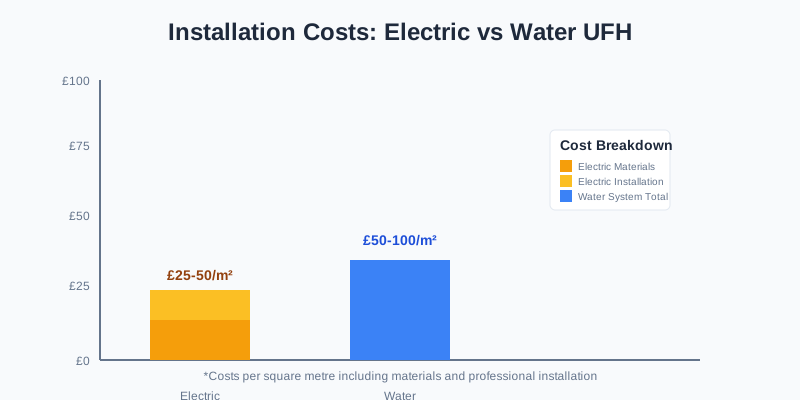
Materials cost (mat only, per m²)
| Brand | Mat type | Wattage | Price per m² |
|---|---|---|---|
| Blyss (B&Q) | Mesh | 150W | £20–30 |
| Klima | Mesh | 150W | £25–38 |
| Ecofloor | Mesh | 150/200W | £28–45 |
| ProWarm | Mesh + Foil | 150/200W | £30–50 |
| Fastwarm | Mesh | 150/200W | £30–55 |
| Devi (Danfoss) | Mesh | 150/200W | £35–55 |
| Warmup | Mesh + Foil | 150/200W | £40–65 |
Full room cost estimate (materials + installation)
| Room | Area | System | Estimated all-in cost |
|---|---|---|---|
| Ensuite | 3m² | Mesh mat + basic thermostat | £350–550 |
| Bathroom | 6m² | Mesh mat + programmable thermostat | £600–900 |
| Kitchen | 10m² | Mesh mat + smart thermostat | £900–1,400 |
| Living room | 15m² | Mesh mat + smart thermostat | £1,200–2,000 |
Additional costs to budget:
- Thermostat: £40–80 (basic), £80–150 (programmable), £120–250 (smart WiFi)
- Rigid insulation boards: £8–15/m²
- Part P electrical connection and compliance certificate: £150–300
- Tile adhesive or self-levelling compound: £5–20/m²
For a full cost breakdown including wet system pricing and ROI analysis, see our Underfloor Heating Costs Guide.
Top UK underfloor heating mat brands
Warmup, market leader
Warmup's StickyMat (150W/m²) and SpeedHeat (200W/m²) are the most widely installed UFH mats in the UK. The self-adhesive mesh simplifies installation, and Warmup backs every mat with a 25-year warranty, the longest on the market.
- Best for: Any installation where longevity and warranty matter most
- Where to buy: B&Q, warmup.co.uk direct, electrical wholesalers
- Price: £40–65/m²
- Pairs with: Warmup 3iE or 6iE smart thermostats (energy monitoring, app control)
ProWarm, best mid-range
ProWarm is a solid mid-range choice with a loyal installer following. It comes in 150W and 200W formats, and the clear installation documents make it a sensible option for your first DIY job.
- Best for: Value-conscious projects, professional installers
- Where to buy: Toolstation, floorheat.co.uk
- Price: £30–50/m²
- Warranty: 10 years
Devi (Danfoss), professional grade
Professional electricians specify Danish-engineered Devi systems regularly. The DEVImat series has a strong reputation for precision and consistency, and contractors often choose it when they need a dependable commercial system.
- Best for: Professional installations, high-specification projects
- Where to buy: Trade electrical wholesalers
- Price: £35–55/m²
- Warranty: 10–20 years
Klima, best budget option
Klima is the accessible budget choice at Screwfix. The mats offer reasonable quality for the money and suit a small bathroom where you want warm tiles without a large upfront cost.
- Best for: Small rooms (3–6m²) on a tight budget
- Where to buy: Screwfix (next-day click & collect)
- Price: £25–38/m²
- Warranty: 10 years
Blyss. B&Q entry-level
Blyss is B&Q's own-brand UFH mat and an easy option for a very small bathroom. It also makes sense if you want simple in-store returns or need to pick up the rest of your tiling materials in the same trip.
- Best for: 3–4m² bathrooms, lowest possible outlay
- Where to buy: B&Q in-store and online
- Price: £20–30/m²
- Warranty: 5–10 years
For a broader comparison including wet system brands, see our Best Underfloor Heating Brands UK Guide. If you're considering Fastwarm specifically, our Fastwarm underfloor heating review covers their mat range, 200W options, and thermostat setup in detail.
Where to buy: UK retailer comparison
| Retailer | Brands available | Range | Delivery options |
|---|---|---|---|
| Screwfix | Klima | Budget | Free click & collect, next-day delivery |
| B&Q | Blyss, Warmup | Budget–Premium | In-store + delivery |
| Toolstation | ProWarm | Mid-range | Free click & collect, next-day |
| Wickes | ProWarm (limited) | Mid-range | Delivery or in-store |
| warmup.co.uk | Warmup full range | Premium | Direct + free design service |
| floorheat.co.uk | ProWarm full range | Mid-range | Online direct |
My buying tip: Screwfix and Toolstation offer the best mix of next-day availability and competitive pricing. For rooms larger than 8m², or a whole-project order, go direct to Warmup or ProWarm. Their technical design teams will check your layout and confirm the sizing before despatch at no extra cost.
How to install an underfloor heating mat: step by step
Our DIY UFH Installation Guide covers both electric and wet systems in full. For a mesh mat under tiles, this is the core process:
Step 1: Calculate your heated area
Measure the total floor area, then subtract every permanent fixture: bath, toilet pedestal, shower tray, kitchen units and built-in wardrobes. Only heat the walkable floor. Putting mat under fixed items wastes energy and risks overheating.
Step 2: Lay insulation boards first
This is the step most DIYers skip, and the efficiency suffers. Lay rigid XPS insulation boards across the entire prepared subfloor before the mat goes down. They direct heat upwards instead of losing it into the slab or joists below. Without insulation, you lose 30–50% of your heat output.
Step 3: Unroll and fix the mat
Unroll from the thermostat wall outward. Use the self-adhesive backing to fix the mat as you go. The mesh can be cut between cable runs to navigate around obstacles and corners, cut the mesh only, never the heating cable. Keep cable runs parallel and never allow cables to cross or overlap.
Step 4: Test resistance before covering
Measure the mat's resistance with a multimeter and compare to the value printed on the packaging. The reading should be within ±10% of the specification. Record this figure, you will need it if you ever need to make a warranty claim. If you skip this test and later damage the cable during tiling, proving the cable was undamaged before cover is impossible.
Step 5: Run the floor sensor probe
Thread the floor temperature sensor probe from the thermostat location to the floor, placing the sensor tip centrally between two cable runs in the middle of the heated area. Run the probe in a conduit so it can be replaced in future without lifting tiles. This sensor is how the thermostat prevents the floor from overheating.
Not sure this is the right page?
Get a reading list built for your project
Three quick questions and we will point you to the guides that match what you are actually trying to do.
Find your starting pointThree questions. About 30 seconds. No sign-up.
Step 6: Cover the mat
For tiles: Apply flexible tile adhesive directly over the mat (3–5mm depth) and tile immediately. Do not use rigid adhesive, it cracks under thermal cycling.
For other floors: Apply 10–15mm self-levelling compound and allow it to cure fully (minimum 24–48 hours before walking on it; follow manufacturer's guidance for full cure before laying floor finish).
Step 7: Electrical connection (certified electrician only)
Under UK Building Regulations Part P, a certified electrician must connect the mat tails and thermostat to the mains supply, conduct insulation resistance testing, and issue a Minor Electrical Works Certificate. This is a legal requirement, not optional, and most mat warranties also require it.
Wiring: how mats connect to your thermostat
Plan the conduit runs before you lay the floor. Once the tiles are down, you can't add cable routes.
Basic wiring principle
The mat has two cable tails. Current flows in at one tail, travels through the entire heating cable, and returns at the other tail. Both tails run back to the thermostat.
Mains (dedicated RCD-protected circuit, 2.5mm²)
        ↓
  Thermostat  ←  Floor sensor probe (between cable runs)
        ↓
  Mat, tail 1 (Live out) → heating cable → tail 2 (Neutral return)
The floor sensor probe is a separate two-wire cable that runs from the thermostat to the floor, monitoring surface temperature. Run it in a 10mm conduit so the probe tip sits centrally between two cable runs, and so the probe can be replaced without disturbing the floor.
Multiple mats in one room
If your room requires more than one mat, wire both in parallel, separate pairs of tails back to the same thermostat terminals (or a contactor relay if the combined load exceeds 3kW). Never wire mats in series.
Maximum load per circuit
Standard practice: maximum 3kW per thermostat and circuit. At 150W/m² this allows up to 20m² per circuit. Larger rooms require either a contactor relay (controlled by the thermostat) or separate circuits with individual thermostats.
S-plan integration
For properties where UFH electric mats need to integrate with an existing S-plan central heating programmer, the UFH thermostat can receive an enable signal from the programmer. This is uncommon in typical single-room installations but relevant if you want the electric UFH to follow the same heating schedule as the rest of the house. Your electrician can wire this as part of the connection.
For thermostat recommendations and smart controls options, see our Smart Thermostats for UFH Guide.
Frequently asked questions
Can you cut an underfloor heating mat?
Yes, you can cut the mesh backing, but never cut the heating cable. Cutting the mesh lets you fold the mat to change direction and navigate obstacles. Use scissors to cut cleanly between cable runs, then fold and redirect. The cable must remain a continuous, unbroken loop throughout.
What is the difference between 150W/m² and 200W/m²?
150W/m² is the standard for well-insulated rooms with efficient flooring (tiles, LVT, stone). Correct for most UK bathrooms and kitchens.
200W/m² is for rooms needing higher output, poorly insulated ground floors, extensions, or rooms with less conductive flooring (carpet, thick engineered wood). It heats faster but uses more electricity.
As a rule: use 200W/m² for concrete ground floors and any room that struggles to reach temperature with 150W. Use 150W/m² for upper floors and well-insulated spaces.
How thick is an underfloor heating mat?
- Mesh mat cable alone: ~3mm
- Mesh mat + tile adhesive: 6–10mm total
- Mesh mat + self-levelling compound: 12–20mm total
- Foil mat: 0.5–3mm
Electric mats have one of the smallest floor height impacts of any heating system, far lower than the 50–100mm required for a screeded wet system. See our retrofitting guide for a full comparison of floor build-ups.
How long do underfloor heating mats last?
Quality mats from established brands last 25–40 years. The resistance cable is sealed in thermoplastic insulation and embedded in adhesive, protecting it from mechanical damage. The thermostat may need replacing after 10–15 years. There are no moving parts. Provided the cable is not damaged during installation, the most common cause of early failure, there is very little to go wrong.
What size mat do I need?
Mats come in fixed sizes: typically 1m², 1.5m², 2m², 3m², 4m², 5m², 6m², 8m², 10m², 12m², 15m², and 16m².
Measure your heated floor area, total room floor area minus fixed furniture footprints. Always round up to the nearest available mat size. Never fold, overlap, or bunch a mat to fit a smaller space, this creates hotspots that damage the floor and void the warranty.
Can underfloor heating mats cause problems?
The most common issues are:
- Cable damage during installation, cutting or piercing the cable accidentally. Prevented by always testing resistance before and after covering.
- Cold spots, usually caused by cable overlap or insufficient insulation. Check layout before covering.
- Thermostat or sensor failure, both are easy to diagnose and straightforward to replace without disturbing the floor.
- Incompatible floor coverings, particularly floating floors laid over mesh mats without proper SLC, or carpets with tog values too high.
For fault diagnosis, see our UFH Troubleshooting Guide.
The decision comes down to three factors: floor type, room size, and budget.
- Tiled bathroom under £600: Klima or Blyss 150W mesh mat from Screwfix or B&Q. Reliable and straightforward.
- Kitchen or ensuite, best long-term quality: Warmup StickyMat 150W or ProWarm equivalent. The 25-year warranty is worth paying for on a floor you won't be lifting again for decades.
- Laminate or floating engineered wood: Foil mat only, confirm your floor product is UFH-rated and your underlay is below 1.5 tog.
- Awkwardly shaped room: Loose cable rather than mesh mats, more installation effort, but precise coverage.
For rooms larger than 15m² being used as a primary heat source, running costs for electric mats will be significant, review our running costs guide to compare against a wet system.
Ready to plan your project? Use our Heat Loss Calculator to confirm your room's heating requirements, then compare mat kits and full system options from leading UK brands.
Need a professional installer? Find certified UFH specialists via the Underfloor Heating Directory.
One useful email,
once a month.
New guides as they go live. Real cost data, not press releases. The occasional rumour from the industry that's actually worth knowing.
No sales pitches. No jargon. Unsubscribe in one click.