Guided reading
Not sure where to start?
Answer three quick questions and we will point you to the right guides for your project.
Find your starting pointThree questions. About 30 seconds. No sign-up.
Quick Answer: A heated driveway costs £70-£200 per m² for the heating system installed, or around £3,100 for a typical UK home. Electric cables or water pipes under the surface melt snow and ice automatically, triggered by a sensor that detects freezing temperatures and moisture together. Running costs are modest because the system only fires during actual snow and ice events. Explore more practical guidance at underfloorheating.info and find suitable specialists through the Underfloor Heating Directory.
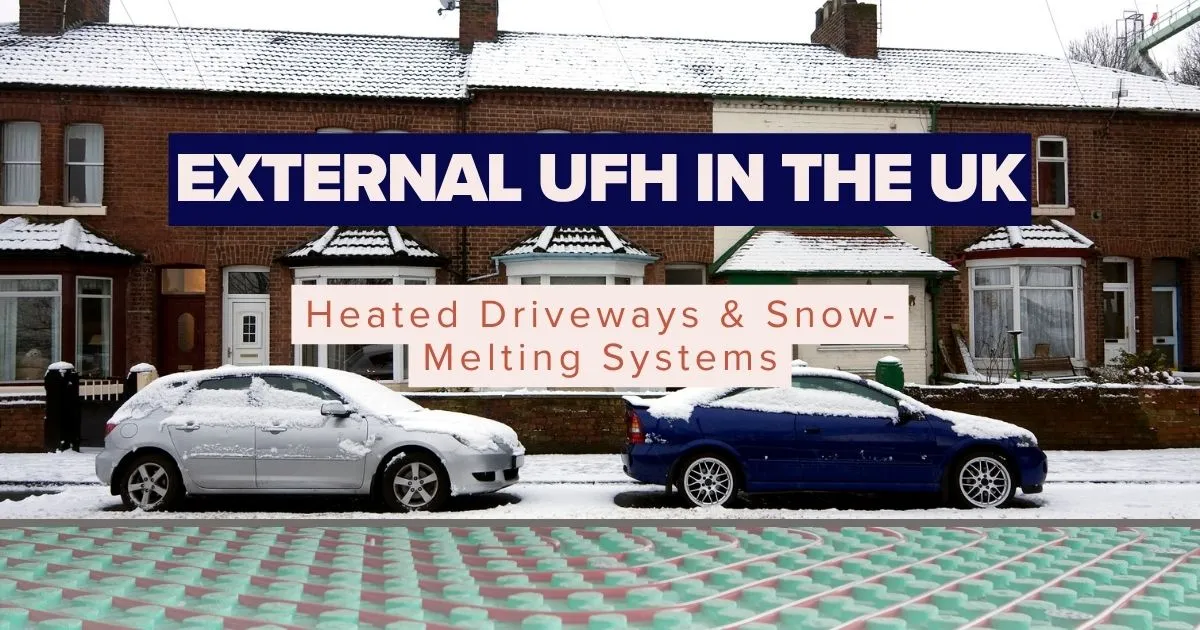
A heated driveway does exactly what the name suggests. Heating cables or water pipes embedded beneath the surface warm it just enough to stop snow settling and ice forming, so the driveway clears itself while you stay indoors. It's the same technology as the underfloor heating in your kitchen or bathroom, adapted for the outdoors, and a small group of UK specialists design and install it for homes, car parks, ramps and even roofs.
This guide covers how driveway heating works, what it costs per square metre in the UK, where snow melting systems make sense, and how to find an installer who's actually done this kind of work before.
What Is a Heated Driveway?
There are two types of system, and they mirror the indoor split between electric and wet underfloor heating.
Electric driveway heating uses resistance heating cables or pre-spaced driveway heating mats laid beneath the surface. A typical snow melting cable gives out a fixed 25W per metre, and installers space the runs closer together where more output is needed. Laid at 80mm centres, that adds up to around 300W per square metre, enough to keep a surface clear at temperatures down to about -20°C. Electric systems suit most domestic driveways because they need no boiler connection, respond quickly and can be zoned to heat only the areas you choose, such as two wheel tracks rather than the full width. If you want the indoor equivalent for comparison, see our electric underfloor heating guide.
Wet (hydronic) driveway heating circulates a heated water and glycol mix through tough PEX tubing under the surface, fed by a boiler or heat pump housed in a garage. Installation costs more because of the pipework, manifold and heat source, but running costs per kilowatt-hour of heat are lower. That's why wet systems tend to win on larger areas like commercial car parks and long private drives; the same logic applies to wet underfloor heating indoors.
So what's actually different from indoor UFH? The job. A living room system raises a floor a few degrees above room temperature. A driveway heater has to push heat through concrete, asphalt or block paving against sub-zero air, wind and falling snow, so it runs at a much higher output per square metre and only when the weather demands it.
How Driveway Heating Systems Work
Modern snow melting systems are automatic. You don't switch them on when the forecast looks grim.
A combined temperature and moisture sensor sits in or beside the heated surface. When the temperature drops near freezing and the sensor detects moisture at the same time, the combination that produces snow and ice, the controller switches the heating on. Once the surface is clear and dry, it switches off again.
This matters for running costs. The system sits idle for most of the winter and only draws power during and just after snowfall or freezing rain. Heating on temperature alone would waste energy on every cold, dry night.
Sizing is done per square metre. An installer will look at the surface material (concrete holds and spreads heat differently to asphalt or paving), the exposure of the site, local climate and how quickly the surface needs to clear, then specify cable spacing and total output to suit. Exposed or free-standing structures such as ramps and bridges get a layer of insulation beneath the heating so the energy goes up into the surface rather than down into the ground.
On a new driveway, the cables or pipes are laid during construction, in the screed, sand bed or asphalt layers. Retrofitting under an existing surface is sometimes possible but means lifting and relaying at least part of it, which is where much of the cost sits.
Heated Driveway Cost UK
For the heating system itself, expect roughly £70 to £200 per square metre installed, depending on the system type, output and how the surface is built up. Industry cost guides put a typical domestic installation at around £3,100, with a realistic range of £1,300 to £4,900. A complete job including a new surface comes in higher: around £6,000 under concrete and £6,700 under asphalt on average.
| Item | Typical UK cost |
|---|---|
| Driveway heating system, installed | £70-£200 per m² |
| Typical domestic installation | £3,100 (range £1,300-£4,900) |
| Full installation under concrete | ~£6,000 |
| Full installation under asphalt | ~£6,700 |
| Removing existing driveway (machine) | ~£50 per m² |
| Removing existing driveway (by hand) | ~£125 per m² |
| Drainage channel and soakaway, if needed | ~£5,000 |
A few ways to keep the price down. Heating only the wheel tracks and a walking strip rather than the whole drive can halve the heated area. Timing the installation to coincide with a driveway you were replacing anyway removes the excavation cost from the equation. And on melt water: a driveway that clears itself produces water that has to go somewhere, so price in drainage from the start rather than discovering it later.
What Does a Driveway Heater Cost to Run?
Running costs depend entirely on the weather, because a sensor-controlled system only runs when snow or ice is actually present. As a worked example, a 20m² heated area at 300W/m² draws 6kW, which at around 27p per kWh costs about £1.60 for each hour of melting. Most UK winters demand a modest number of running hours, which is why the sensor control matters more to your bill than the headline wattage.
For comparison with indoor systems, see our underfloor heating cost guide and running costs breakdown. The numbers above are for exterior snow melting only and sit well above indoor £/m² rates, because the output requirement is several times higher.
Where Snow Melting Systems Are Used
Domestic driveways are the obvious application, but the same embedded-cable approach shows up in more places than most people expect.
Ramps and loading bays. An icy ramp is a real hazard for vehicles and staff, and gritting a steep slope is a losing battle. Underground car park entrances, commercial loading platforms and access ramps are among the most common commercial installations, and free-standing ramps are insulated underneath so the heat stays in the slab.
Paths, steps and pedestrian areas. Outdoor steps, walkways and entrances to public or commercial buildings, where a slip becomes a liability question as much as a safety one. Heating also removes the need for constant salting, which damages concrete and the surrounding planting over time.
Roofs and gutters. Self-regulating heating cables run along roof edges, valleys, gutters and downpipes to stop ice dams forming and to keep melt water draining. Self-regulating cable increases its output as the temperature falls, so it can run along a gutter without a separate controller.
Exposed pipework. The same cable family provides frost protection for external and unheated-space pipes, trace-heated along their length to stop freezing and bursts.
A snow melter, to use the term you'll see in some product listings, is simply any of these systems packaged for a specific surface. The underlying cable technology is shared across all of them.
Heated Driveway Mats: The Plug-In Alternative
If embedding cables is more commitment than you want, portable heated driveway mats are laid on top of the surface and plugged in for the winter. A driveway heat mat of this kind clears a strip for wheels or a walkway rather than the whole drive, costs a few hundred pounds rather than a few thousand, and packs away in spring.
The trade-offs are appearance, trailing connections and coverage. They're a reasonable answer for a short path or a single parking spot, but for whole-driveway melting the embedded systems above do the job properly. Don't confuse them with indoor underfloor heating mats, which are a different product for a different job.

Are Heated Driveways Worth It in the UK?
Fair question, given how rarely much of the UK sees settled snow.
Not sure this is the right page?
Get a reading list built for your project
Three quick questions and we will point you to the guides that match what you are actually trying to do.
Find your starting pointThree questions. About 30 seconds. No sign-up.
The case is strongest where one or more of these apply: a sloped or shaded drive that ices even when the road is clear, a household member for whom a fall would be serious, a property in the Pennines, Scotland or Northern Ireland where snow is a yearly certainty rather than an occasional event, or a commercial site with a duty of care to staff and visitors.
For a flat drive in the mild south that sees snow twice a winter, the maths is harder to make work, and a pair of heated mats may be the more sensible spend. If you're weighing up the indoor version of this question, we've covered it in is underfloor heating worth it?
What the system replaces also counts for something: no early-morning shovelling, no grit staining the block paving, and no frost damage from repeated freeze-thaw cycles and salt, which shortens the life of concrete surfaces.
Choosing a Specialist
Driveway heating is a niche within a niche. Plenty of firms install underfloor heating; far fewer have designed an exterior snow melting system, and the design questions are different: output per square metre for your local climate, sensor placement, drainage for melt water, and coordination with whoever is laying the surface. Ask directly for examples of exterior work, not just indoor UFH projects.
The vetting process is otherwise the same as for any underfloor heating job. Our guide to UK installer qualifications covers what certifications to look for, and the directory's guide on how to choose a UFH installer walks through the full selection process. You can also browse vetted installers directly.
I'd ask any firm you shortlist whether they handle frost protection and snow melting alongside standard UFH. Many of the established specialists do without advertising it prominently.
A UK Specialist in Practice: Gaia Climate Solutions
Gaia Climate Solutions, a Suffolk-based firm with over 30 years in underfloor heating, is a good example of how this work sits alongside standard UFH. Alongside wet and electric indoor systems, Gaia designs and installs DEVI ice and snow melting systems for driveways, car parks, ramps, steps and loading platforms, plus roof and gutter de-icing and pipe frost protection.
Their ground systems pair DEVIflex heating cables with DEVIreg thermostats and sensors that register snow and ice automatically, and the systems they install protect surfaces at temperatures down to -30°C. One of their published case studies covers a frost protection system installed on the driveway of a London property, which is precisely the kind of exterior project this guide has been describing.
That combination of indoor underfloor heating and exterior snow melting from the same specialist is typical of the firms that do this well. The design skills carry over; only the application changes.
Frequently Asked Questions
How much does a heated driveway cost in the UK? Around £70 to £200 per m² for the heating system installed, with a typical domestic project at about £3,100 before any resurfacing. A complete new heated driveway averages £6,000 to £6,700 depending on the surface.
Do heated driveways work with any surface? Systems are available for concrete, asphalt, block paving and stone. Asphalt needs cables rated for the high temperatures of laying, so tell your installer what surface you're planning.
Can I add driveway heating to my existing driveway? Sometimes, but it means lifting and relaying part of the surface, and systems buried without inspection tend to carry short warranties. The economics are best when you're replacing the driveway anyway.
How much electricity does a driveway heater use? Output runs at 250 to 300W per m², but a sensor-controlled system only runs during snow and ice events. A 20m² area costs roughly £1.60 per hour of melting at current electricity prices, and most winters require only a modest number of hours.
Is planning permission needed? The heating itself doesn't need permission, but standard driveway rules still apply: in England, an impermeable surface over 5m² draining onto the road needs planning consent, so design melt water drainage in from the start.
New to underfloor heating altogether? Start with our beginner's guide →
One useful email,
once a month.
New guides as they go live. Real cost data, not press releases. The occasional rumour from the industry that's actually worth knowing.
No sales pitches. No jargon. Unsubscribe in one click.