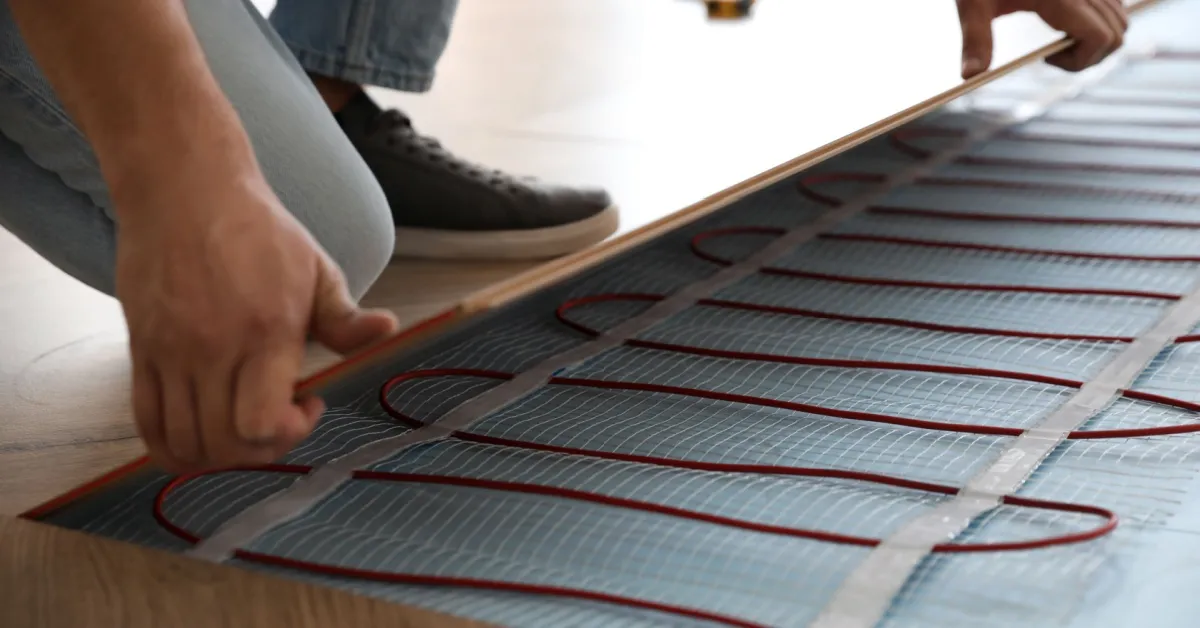
Quick answer: Underfloor heating is comfortable, quiet and good at freeing wall space, but it is not automatically the cheapest or quickest heating option. Electric systems suit small, intermittently used rooms. Wet systems suit larger areas and work well with a heat pump, provided the floor is insulated and the system is designed properly.
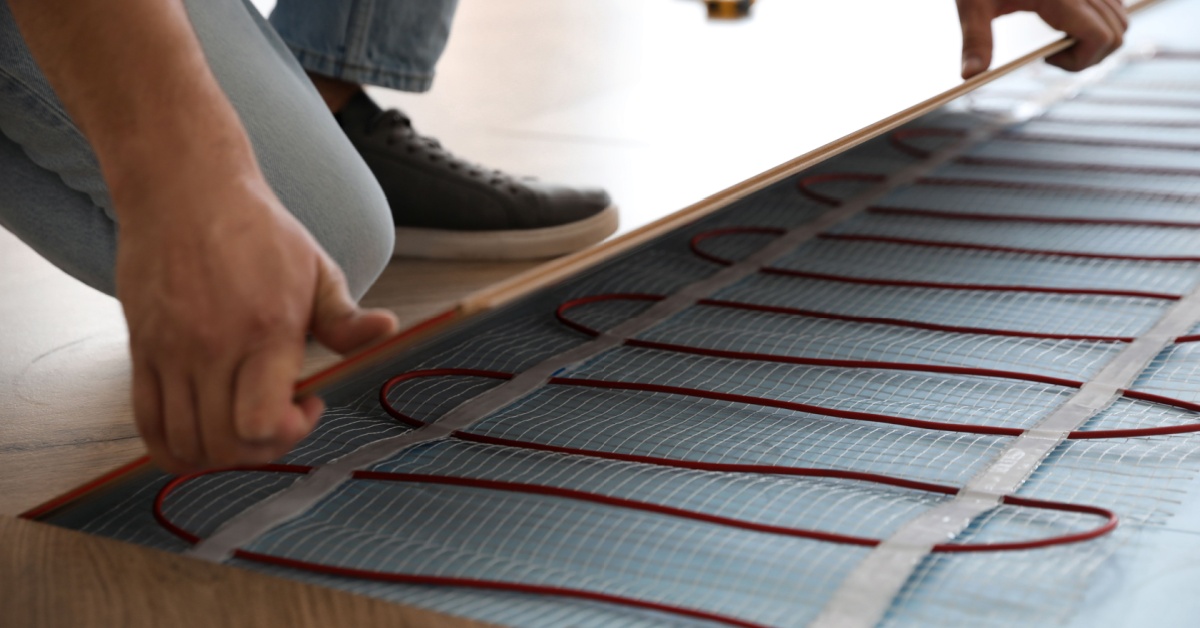
Underfloor heating can be a good decision in the right project, but it can also be an expensive disappointment when the room needs quick heat, the floor cannot be raised, or nobody has checked the heat loss and insulation first.
This guide compares the real benefits and drawbacks of the three main choices:
- Electric UFH, where a mat or cable heats the floor directly.
- Wet UFH, where warm water travels through pipes in the floor.
- Heat-pump UFH, which is a wet system supplied by an air or ground source heat pump rather than a separate type of floor heater.
The electric versus wet comparison is useful if you are still deciding between the two basic systems. The heat-pump UFH guide covers flow temperatures, efficiency and design in more detail.
The benefits of underfloor heating
1. Comfortable, even warmth
UFH distributes heat across the floor instead of heating a small, hot area near a wall. That can give a more consistent room temperature, with fewer cold corners and less movement of dusty air. The floor itself can be warm to walk on, which many people notice first in a bathroom or bedroom.
The trade-off is that a floor is not always the best way to heat a room quickly. The comfort gain is strongest when the system is designed for the room and the floor finish.
2. More design freedom
Without radiators, you gain usable wall space and avoid decisions about where a radiator will obstruct furniture. That can help with open-plan layouts, built-in storage and low-level windows. It also removes some visible heating hardware, although the manifold, pipes, controls and heat source still need space and access.
Electric mats add less floor build-up than many wet systems, so they can be easier to fit where doors, thresholds and floor height are tight. Wet systems usually need more construction work, but they can be built into a new floor without taking space away from the room.
3. Good long-term efficiency when the design is right
Wet UFH can operate at lower water temperatures than traditional radiators. That can improve the efficiency of a condensing boiler and is particularly useful with a heat pump, which generally performs better when it does not need to produce very hot water.
The Energy Saving Trust explains that lower flow temperatures can reduce energy use, but it also stresses that savings depend on the heat source, property, floor finish and how the system is used. See its underfloor heating advice and heat-pump guidance.
Efficiency is not the same as a low bill. A poorly insulated floor sends heat downwards, a thick floor covering resists heat, and a badly controlled system heats an empty room. Design and controls matter as much as the label on the heat pump.
4. Quiet operation and low visible maintenance
Once commissioned correctly, a floor system has no moving fan, clanking metal or exposed hot surface in the room. The pump or boiler may make some noise elsewhere in the property. Wet UFH still needs periodic checks, such as pump operation, pressure and controls. Electric systems have no circulating pump, but they still need correct electrical protection and sensible thermostat settings.
The drawbacks of underfloor heating
1. Installation is disruptive and can be expensive
UFH is easiest during a new build or a major renovation. A retrofit can mean lifting a floor, adding insulation, changing screeds, raising thresholds and making good afterwards. A wet system also needs pipework, a manifold, a heat source connection and commissioning. Electric systems are simpler, but the electrician, floor preparation and final floor covering still add to the price.
Get a room-by-room quote rather than comparing a headline price per square metre. Ask whether the quote includes insulation, controls, screed or levelling, floor finish, manifold, commissioning and making good. The underfloor heating installation cost breakdown explains the items that often get left out of a cheap quote.
2. Wet systems are slow to heat up
A water-based floor with screed has thermal mass. It may take hours to warm properly, and a morning warm-up after a cool night can be disappointing if you expect the same response as a radiator. The floor may still feel warm long after the circulating water has stopped, but that stored heat needs to be created in the first place.
Electric mats respond faster, but they are not instant either. Their warm-up time depends on the mat, the floor build-up, the floor covering, the starting temperature and the thermostat. Avoid treating a quoted response time as a promise for every room.
3. Running costs depend on the heat source
Direct electric heating turns the electricity you buy into roughly the same amount of useful heat at the mat. It is usually best reserved for a small room, a short warm-up or a bathroom where comfort matters more than heating the whole home. The Energy Saving Trust says electric UFH can be effective for quick warming of small areas but is usually more expensive to run over long periods than wet systems using cheaper or more efficient heat sources.
Wet UFH is not automatically cheap either. A gas-fed system, oil-fed system and heat-pump system have different tariffs, efficiencies and control requirements. Use the running costs guide and the detailed electric versus wet running-cost comparison for the numbers. Compare the cost of useful heat, not just the fuel name.
4. Repairs can involve the floor
Electric systems can have a local electrical fault in a mat or cable, but tracing it may mean lifting the finished floor. Wet systems can have a leak, failed pump, faulty actuator, blockage or air lock. The floor itself does not normally fail just because the heating is not working, but reaching the pipework or manifold may still be disruptive.
A reputable installation, clear system documentation and sensible commissioning reduce uncertainty. Our annual maintenance checklist and guide to when to call a professional cover the checks worth making after installation and during normal use.
Electric UFH: benefits and drawbacks
Electric UFH is usually the practical choice for a bathroom, shower room, small bedroom or conservatory when the floor is already being renewed and short, targeted warmth is the main goal. It can be installed without a boiler, gas supply or wet pipe circuit, and many modern mats are thin enough for selected retrofit projects.
Its strongest benefits are simple installation, good response relative to wet screed, independent room control and low mechanical complexity. It also gives excellent underfoot comfort in a small area. These are the reasons electric systems remain common in bathrooms.
The drawback is running cost. A larger mat, a high output or a room left on for hours uses substantial electricity. Electric UFH is less convincing for a large open-plan living area, a regularly occupied home or anyone wanting to heat many rooms on a standard electricity tariff. It also needs a suitable circuit, earthing and a thermostat that protects the floor finish. A thick carpet or resilient underlay can trap heat, so check the best flooring for underfloor heating before choosing a floor.
Choose electric when: the area is small, the room is used intermittently, quick response matters, the floor height is restricted or there is no practical wet heat source.
Avoid electric as the main heating choice when: you need to heat a large area for long periods, the home is poorly insulated and the budget depends on low running costs.
Wet UFH: benefits and drawbacks
Wet UFH is the better long-term option for larger, regularly heated areas, especially when paired with a low-temperature heat source. The pipes can serve several rooms or floors through a manifold, and the screed provides useful thermal mass. It is quieter at room level and has no exposed radiators taking up wall space.
Its drawbacks are construction complexity and response time. It needs a suitable heat source, pipe layout, pump, controls, floor insulation and commissioning. The floor finish must tolerate the design temperatures. A room with high heat loss may need a different emitter, extra insulation or a separate heat source, otherwise the floor can be asked to deliver more heat than it was designed to provide.
Choose wet when: you are building or renovating, the home will be occupied regularly, several rooms need heating or the plan includes a heat pump or a boiler already capable of low-temperature operation.
Choose something else when: the project is a small, isolated room, you need same-day warmth, floor height is impossible to change or disruption and upfront cost are the main concerns.
Heat-pump UFH: benefits and drawbacks
A heat pump is the heat source, not a third floor construction method. The most common arrangement is a reversible air-to-water heat pump feeding a wet UFH circuit. The match works because a large floor surface can deliver heat at a relatively low flow temperature, allowing the heat pump to operate efficiently.
The benefits can be substantial. The system may use less electricity than direct electric heating for the same useful warmth, and it can provide low-carbon space heating and hot water from one system. A properly designed heat pump and UFH combination can also be quiet and comfortable.
The drawbacks are upfront cost, outdoor equipment, design responsibility and dependence on the property. The heat pump needs adequate space, a suitable electrical supply and a design that meets the building's heat loss. A floor with poor insulation or a covering that resists heat can force a higher flow temperature, which may reduce efficiency. Very cold outdoor conditions, defrost cycles and how the system is controlled also affect real seasonal performance. Ofgem explains how seasonal performance factor is calculated in its heat-pump SPF guide.
Choose heat-pump UFH when: the property is reasonably insulated, you want a low-carbon whole-home heating strategy and the budget includes the heat pump, electrical work, hot water, controls and floor construction.
Be cautious when: the property has very high heat loss, the electrical supply needs upgrading, the outdoor location is unsuitable or the expected savings are based only on the heat pump's maximum rating.
Accessibility and physical comfort
UFH is particularly useful for people who want even warmth underfoot, but accessibility depends on the whole design. A floor surface that is too hot can be uncomfortable for children, older people, pets or anyone with reduced sensation. Low-temperature water, properly selected floor finishes and reliable controls matter.
Do not assume a thermostat guarantees safety. For electric systems, use an appropriate floor sensor and follow the floor finish manufacturer's temperature limits. For wet systems, ask the designer about surface temperature and zoning, not only room temperature. A bedroom may need a lower setting than a bathroom, and a room occupied by someone with mobility needs may benefit from even coverage and sensible access to controls.
Which system is most suitable?
A short decision table helps:
| Priority | Likely choice | Main compromise |
|---|---|---|
| Small bathroom or shower room | Electric | Higher cost per useful kWh if left running long |
| Open-plan room or several regularly used rooms | Wet | More installation work and slower warm-up |
| Whole-home low-carbon heating | Heat-pump UFH | Higher upfront cost and careful design needed |
| Quick response in a cold room | Usually radiators or electric | UFH is less responsive, especially with screed |
| Restricted floor height | Electric or a low-profile wet system | Product and floor-cover limits may apply |
| Frequent DIY maintenance preference | Electric, with qualified installation | Electrical faults may still require floor access |
The best choice is not the one with the longest list of benefits. It is the one that meets the room's heat loss, expected occupancy, existing heat source and maintenance tolerance.
The questions to ask before you commit
- What is the room-by-room heat loss, and what output has the floor been designed to provide?
- How long does the room need to take to become comfortable?
- Is the floor insulated, and what floor covering will be installed?
- What heat source will supply the system?
- What happens if the system fails, and how easily can a component be reached?
- What controls and temperature limits are specified?
- Are the costs based on the complete installation or only the heating components?
- What is the expected annual use, not just the rated output?
For new work and alterations, the current Approved Document L guidance from GOV.UK is an important reference. It does not replace a room-by-room design or a quote from a competent installer.
The honest decision
UFH wins on comfort, even distribution and design freedom. It is especially attractive when a renovation gives you easy access to the floor and you intend to stay in the property.
Electric UFH wins on access and response, but it is usually a room-scale comfort system rather than the cheapest way to heat a large home. Wet UFH wins when the property needs a properly designed distribution system, but it costs more to install and can be slow to warm. A heat pump can make that wet system more efficient and low carbon, but only when the building, floor and heat source are designed as one system.
If you want a quick starting point, compare underfloor heating costs with the underfloor heating versus radiators guide. Then ask for a written design showing the heat source, insulation, controls, expected response and what is excluded from the price. That is the honest way to choose UFH, rather than choosing on comfort alone.
One useful email,
once a month.
New guides as they go live. Real cost data, not press releases. The occasional rumour from the industry that's actually worth knowing.
No sales pitches. No jargon. Unsubscribe in one click.