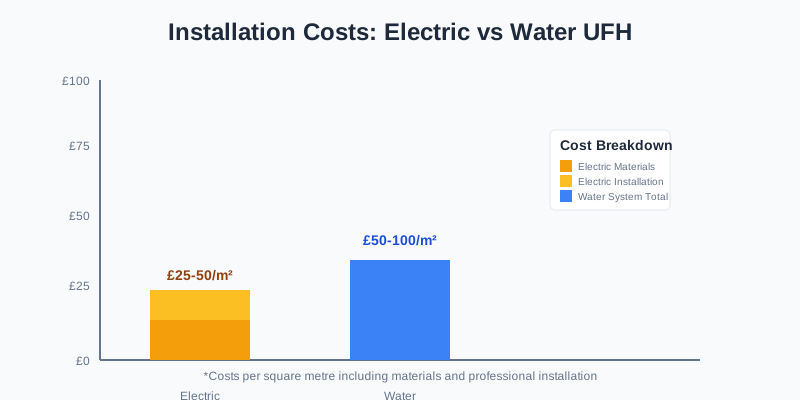
Quick answer: Electric underfloor heating can be sensible for a small room that is heated intermittently. Wet underfloor heating is usually the better running-cost choice for larger, regularly heated areas, especially when supplied by a heat pump. The honest comparison is not wattage against wattage. It is useful heat delivered, energy used to produce it, the hours it runs and the tariff you pay.
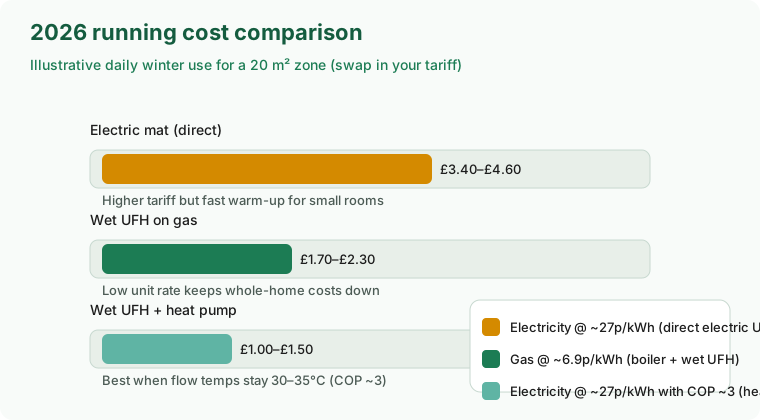
The short version
Electric UFH turns electricity into heat at the point of use. A mat rated at 150 W/m² does not automatically cost 150 W every hour. The thermostat, room heat loss, floor covering, insulation and how long you need warmth all affect the energy you actually buy.
Water UFH moves heat from a boiler or heat pump through pipes in the floor. The mat's wattage comparison is therefore not directly applicable. The useful figures are the room's heat loss, the heat source efficiency and the delivered water temperature.
For a quick decision, use these rules:
- Electric makes sense where the heated area is small, response time matters and the room isn't heated all day.
- Water on a gas boiler can be economical where you already have a suitable boiler and the system is well designed.
- Water on a heat pump is likely to win over time if the heat pump can supply low flow temperatures and the property is reasonably insulated.
- Poor controls, a cold floor beneath the system and a high-resistance floor finish can erase the expected advantage.
This is a comparison of operating costs, not a replacement for the broader electric vs water underfloor heating comparison. For general room-by-room running costs, see the underfloor heating running costs guide.
The variables that decide the bill
Before comparing headlines, write down these variables:
| Variable | Electric UFH | Water UFH |
|---|---|---|
| Energy bought | Electricity | Gas or electricity for the heat source |
| Useful heat | Electrical resistance output | Boiler or heat-pump output delivered to the floor |
| Main design input | Mat power in W or W/m² | Room heat loss in W |
| Efficiency adjustment | Usually close to 1.0 at the mat, before controls | Boiler seasonal efficiency or heat-pump SPF or COP |
| Runtime | Often short, targeted periods | Often longer or continuous with thermal mass |
| Main losses | Heat escaping through the room and floor build-up | Boiler, pump, distribution and floor losses |
| Key tariff factors | Unit rate, standing charge, time-of-use tariff | Gas unit rate, standing charge, heat-pump electricity rate |
A simple energy calculation is:
Energy bought = useful heat required ÷ source efficiency
Then:
Running cost = energy bought × tariff per kWh + any standing charge
The standing charge is shared across the whole home, so don't assign all of it to one room when comparing a heating system. It still matters to the household bill, but it isn't a useful way to say that a particular UFH circuit costs a fixed amount per day.
Why mat wattage isn't running cost
Suppose a bathroom mat is labelled 150 W/m² and covers 4 m². While the mat is powered, it draws 600 W, or 0.6 kW.
At an electricity unit rate of 26.32 pence per kWh, one full hour at full power costs:
0.6 kWh × £0.2632 = £0.158
That is the cost while it runs. It is not the daily or monthly cost. The mat may run for a short warm-up, then switch off while the floor gives heat to the room. It may be programmed for a brief morning boost, or it may be left on for hours. A thermostat's location, the floor sensor and the room's heat loss decide the real consumption.
The same point applies to a 200 W/m² mat. Twice the watts means twice the energy while it is running, not twice the bill in every home. A smaller room with good insulation may need less runtime. A large, draughty room may need more heat and longer runtime.
Use current tariffs as inputs, not as a promise
Ofgem publishes average unit rates and standing charges for the price cap period. For 1 October to 31 December 2026, its average Direct Debit figures for England, Scotland and Wales are 26.32 pence per kWh for electricity and 7.97 pence per kWh for gas. These are average cap figures, not a quote for every home. Check your own tariff, region, payment method and meter type in Ofgem's price cap unit rates and standing charges table.
The examples below use rounded figures that are easy to replace:
- Electricity: £0.26 per kWh
- Gas: £0.08 per kWh
- Standard household standing charges: excluded from room examples
- A 30-day month: used only where a monthly illustration helps
Those assumptions are deliberately transparent. A supplier discount, a regional cap rate or an Economy 7 tariff can change the result. The Energy Saving Trust also notes that electricity is generally more expensive than gas, so electric UFH is normally more suited to targeted use than whole-house heating. See its underfloor heating advice.
Worked example 1: a small bathroom with electric UFH
Assume:
- 4 m² of mat
- 150 W/m² output
- 0.6 kW electrical demand while running
- 1.5 hours of operation per day
- electricity at £0.26 per kWh
Energy bought per day:
0.6 kW × 1.5 hours = 0.9 kWh
Energy cost per day:
0.9 kWh × £0.26 = £0.234
Over 30 days, the variable energy cost is about £7.02, before standing charges and any tariff adjustments.
Now change the assumption to 0.9 hours per day. The same mat costs about £0.14 per day, or £4.20 over 30 days. No equipment changed. The schedule did.
This is why a mat's wattage is not a running-cost prediction. You need the room size, heat loss, floor construction, control setup and actual operating time. The electric underfloor heating systems guide explains the different electric layouts, while the running costs guide covers broader room calculations.
Worked example 2: a living room with gas-fed water UFH
Assume:
- 30 m² heated area
- design heat loss of 60 W/m²
- useful heat demand of 1.8 kW
- boiler seasonal efficiency of 85%
- gas at £0.08 per kWh
- 8 equivalent hours of heat demand per day
Gas energy required:
1.8 kW ÷ 0.85 = 2.12 kW of gas energy
Daily cost:
2.12 kW × 8 hours × £0.08 = £1.36
For 30 days, that is approximately £40.80 in gas energy, before the gas standing charge and any other household use.
The floor is not being assumed to deliver 60 W/m² for eight full hours regardless of conditions. This example simply converts a design heat load and operating equivalent into a transparent cost. In practice, weather compensation, control schedules, heat loss and boiler modulation change the result.
The important design choice is flow temperature. A condensing boiler can operate efficiently when water is cool enough, but a badly insulated floor or an over-insulated floor finish can force a higher water temperature. Ask the designer to state the design flow temperature and expected seasonal efficiency rather than quoting a generic boiler percentage.
Worked example 3: the same wet floor with a heat pump
Keep the same 1.8 kW useful heat demand. Assume the heat pump's seasonal performance factor for the design is 3.0, and electricity costs £0.26 per kWh.
Electricity required:
1.8 kW ÷ 3.0 = 0.6 kW
For 8 equivalent hours:
0.6 kW × 8 hours × £0.26 = £1.25 per day
At 30 days, that is approximately £37.50 in electricity energy. It is close to the gas example in this assumed case, not dramatically cheaper.
At an SPF of 3.5, the same useful heat would require 0.514 kW of electricity and cost about £1.07 per day. At an SPF of 2.5, it would require 0.72 kW and cost about £1.50 per day. The useful comparison is the heat pump's real seasonal performance, not its maximum rating.
The Energy Saving Trust explains that a wet system paired with a heat pump can be more energy efficient than a traditional boiler and radiators, but savings depend on the property, tariff, floor finish and system design. The heat pump and underfloor heating guide covers flow temperature, COP and design. Ofgem's heat-pump SPF guidance also explains SPF as heat output divided by electricity input, averaged over a year.
Floor output is a limit, not a promise
A wet floor's output depends on pipe spacing, water temperature, the floor build-up and the finish. A floor designed for 50 W/m² is not automatically capable of meeting a 100 W/m² heat loss.
An electric mat is different. Its rated wattage tells you its electrical input and, at the point of use, its heat output. It doesn't tell you how much heat the room needs. Installing 200 W/m² because it feels powerful can overheat the floor without reducing the energy needed to keep the room comfortable.
Ask for a room-by-room heat-loss calculation. Record the required output, the pipe or mat specification, the floor covering and the control strategy. The government publishes Approved Document L, Volume 1: Dwellings, including guidance on dwelling energy efficiency and heating systems. Use the applicable document and a qualified designer for the actual project.
Insulation changes the running-cost maths
A cold slab, suspended floor or unheated void draws heat away from the heating layer. The system then works harder, and the heat source may need a higher flow temperature. That is particularly expensive for a heat pump, where a higher flow temperature can reduce COP or SPF.
Good floor insulation doesn't mean choosing the thickest board available. The right specification depends on the floor type, structure, moisture risk, available height and compatibility with the screed, adhesive or timber deck. Our underfloor heating floor insulation guide explains the materials, placement, edge insulation and retrofit constraints.
Also check the floor finish. A thick rug, resilient underlay or high-tog carpet can resist heat leaving the floor. That can make the surface feel cooler and cause occupants to raise the setpoint. A low-resistance finish is generally more suitable, subject to the flooring manufacturer's instructions.
Controls decide how much heat you buy
Thermostats don't make heat cheaper by themselves. They help avoid heating empty rooms, overheating bathrooms and repeatedly reheating a poorly controlled floor.
Useful controls include:
- separate room or zone schedules for different uses;
- a floor sensor for electric mats where comfort and overheating are concerns;
- weather compensation for wet systems;
- open-window or presence detection where it suits the household;
- a conservative setback that does not create a long, expensive morning reheat.
For an electric bathroom, a short scheduled warm-up can make sense. For a wet floor with screed, the control strategy may be better as a longer, moderate cycle that uses the floor's thermal mass. Neither pattern is universally right. The room's heat loss and how the occupants live decide which one works.
A heat pump should also be sized from heat loss, not from the size of the radiators it replaces. A system that is oversized may cycle inefficiently, while one that is undersized may call for backup heat on cold days. The heat-pump UFH guide covers the design questions in more detail.
Tariffs can change the answer
A standard-rate electric mat uses electricity at the normal unit rate. Some households have time-of-use tariffs that make controlled pre-heating cheaper, but the schedule must suit the household and the system. A mat left on during an expensive peak period is not made economical by owning a time-of-use meter.
Wet UFH on a gas boiler uses the gas tariff. A heat-pump-fed wet system uses electricity, but its useful heat output can exceed the electricity input. Compare the cost per useful kWh of heat, not just the tariff label:
Cost per kWh of heat = tariff ÷ efficiency or SPF
Using the rounded example rates:
- Electric mat: £0.26 per kWh of useful heat at the mat.
- Gas boiler: £0.08 ÷ 0.85 = about £0.094 per kWh of useful heat.
- Heat pump at SPF 3.0: £0.26 ÷ 3.0 = about £0.087 per kWh of useful heat.
- Heat pump at SPF 2.5: £0.26 ÷ 2.5 = about £0.104 per kWh of useful heat.
These are illustrative figures, not forecasts. The Energy Saving Trust's electric heating guidance explains why electric heating is usually more expensive to run than gas and why short, targeted use changes the practical picture.
Room use is part of the answer
A 4 m² bathroom used for 45 minutes before a shower is a different decision from a 4 m² bathroom kept warm all day. A 30 m² living room used every evening is a different decision from a guest room heated only when guests arrive.
Ask these questions before choosing:
- Is the room heated continuously, on a schedule, or only before use?
- How quickly does it need to become comfortable?
- Is the system heating one room, several zones or a whole floor?
- What heat source is already installed?
- Can the floor reach the required output at a sensible flow temperature?
- What does the design heat-loss calculation say?
- What is your actual tariff, including any standing charge and time-of-use restrictions?
The best system is the one that meets the room's use without wasting energy. That is why electric UFH can be the sensible choice for a bathroom and wet UFH can be the sensible choice for a regularly occupied home, even though electricity and gas prices point in a different direction.
What to ask for before you install
Ask for a written comparison that includes:
- room-by-room heat loss;
- mat wattage or wet-floor design output;
- boiler seasonal efficiency or heat-pump SPF assumption;
- design flow temperature;
- floor insulation and finish assumptions;
- control schedules and sensor positions;
- estimated annual runtime or heat demand;
- your actual electricity or gas tariff.
Then ask the installer or designer to show the calculation. If the answer is a single price per square metre with no variables behind it, it isn't a running-cost estimate. For the wider choice of system, use the electric versus water comparison and our underfloor heating costs guide.
The practical conclusion
Electric UFH is not automatically expensive, but it is exposed to the electricity unit rate every time the mat runs. Water UFH has more moving parts, yet it can use a cheaper or more efficient heat source and suit longer, zoned heating schedules.
The lowest sensible cost comes from matching the system to the room:
- choose electric for small, intermittent areas where quick response is useful;
- choose gas-fed water UFH where the boiler and building make that practical;
- choose heat-pump-fed water UFH when the heat loss, insulation and flow temperature support good seasonal performance;
- specify controls and insulation as part of the design, not as afterthoughts.
Start with your actual tariff and a proper heat-loss calculation. The finished number will still be an estimate, but it will be a useful one rather than a guess based on a mat label.
Official sources
- Ofgem: energy price cap unit rates and standing charges
- GOV.UK: Approved Document L, Volume 1: Dwellings
- Ofgem: Easy guide to heat pumps and SPF
- Energy Saving Trust: underfloor heating
- Energy Saving Trust: electric heating
One useful email,
once a month.
New guides as they go live. Real cost data, not press releases. The occasional rumour from the industry that's actually worth knowing.
No sales pitches. No jargon. Unsubscribe in one click.