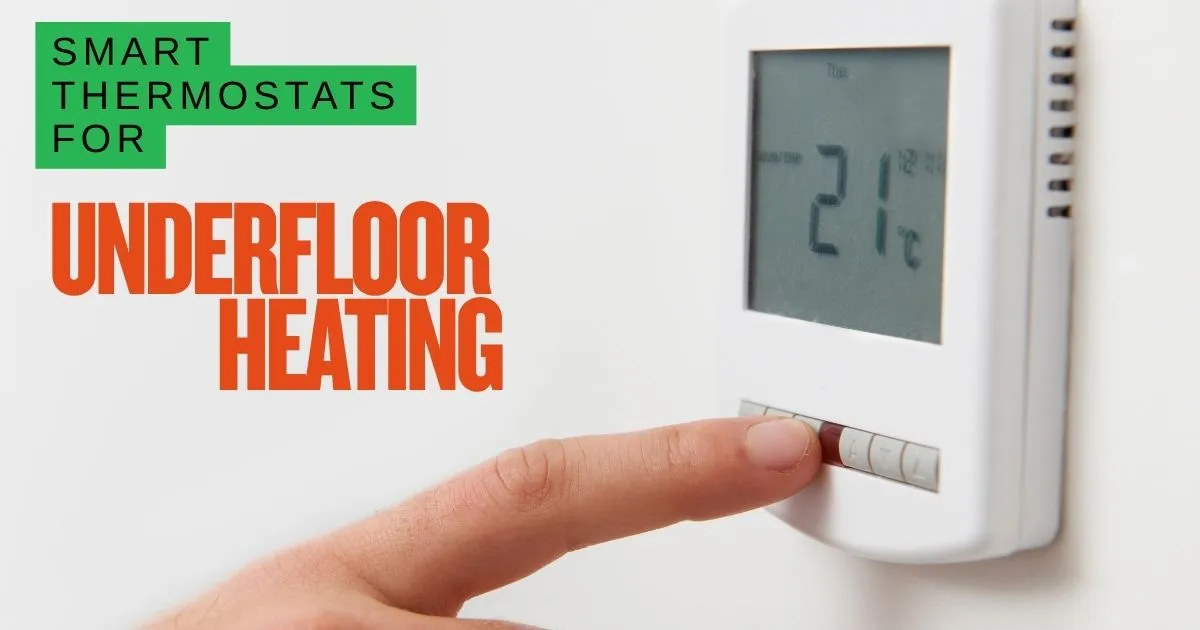
Quick answer: Your controls must match the heating load (16 A for electric, 3 A or volt-free for wet), the floor finish (floor probe for wood/LVT), and the zoning plan. Start with the system type and number of zones, then choose a brand with current UK support and proven manifold integration. The table below compares the main ecosystems. For a simpler type selector, see our thermostat comparison. For smart features and ecosystems, see the smart thermostat guide.
Guided reading
Not sure where to start?
Answer three quick questions and we will point you to the right guides for your project.
Find your starting pointThree questions. About 30 seconds. No sign-up.
Ready to start your project? Plan it with the Underfloor Heating Directory and explore more practical guidance at underfloorheating.info, then find qualified installers through the installer directory.
1. The Electrical Boundary: Wet vs Electric Controls Are Not Interchangeable
Before buying any thermostat, you must know whether your system is electric (dry) or hydronic (wet). They look similar on the wall but their switching hardware is fundamentally different.
| Technical parameter | Electric (dry) UFH controls | Hydronic (wet) UFH controls |
|---|---|---|
| Heating medium | Electric resistance cables or carbon mats | Warm water in PEX/PE-RT pipes in screed or overlay |
| Switching load | High load: 16 A resistive (up to 3,600 W at 230 V) | Low load: 3 A inductive or volt-free relay |
| Signal destination | Directly switches mains power to the floor mat | Signals a central manifold wiring centre |
| Primary sensor | Mandatory floor probe (10 kΩ, 12 kΩ, or 15 kΩ NTC) | Built-in air sensor; optional floor limit probe |
| Surface protection | Hard cut-off via floor probe (27 °C max wood/LVT; 29 °C tile) | Manifold mixing valve + optional floor probe |
| UK regulations | BS 7671 (18th Edition) / Part P (wet zones) | Building Regs Approved Document L (zoning & interlocks) |
Safety warning: Never wire a 3 A hydronic thermostat to an electric heating mat. The 16 A resistive load will fuse the relay contacts, melt the casing and create a fire hazard. If you need to switch a load above the thermostat’s rating, a suitably rated contactor must be installed by a qualified electrician: this is not a DIY workaround.
NTC floor probes: 10 kΩ, 12 kΩ or 15 kΩ are not interchangeable
Different manufacturers use different resistance curves at 25 °C:
- 10 kΩ NTC: Heatmiser, ENGO, SALUS, Thermotouch, ProWarm, Aqara
- 12 kΩ NTC: Warmup, OJ Electronics OEM platforms
- 15 kΩ NTC: DEVI / Danfoss
If the probe is already tiled in, either buy a replacement thermostat that supports the existing curve, or choose an installer-friendly model (Heatmiser neoStat-e, ENGO E-ONE/E20i, Warmup 6iE) that lets you select the probe type in the menu. Do not guess: an incorrect curve gives false temperature readings.
2. Thermal Response: Why Standard Boiler Stats Fail on UFH
Radiators run at 65–75 °C and heat a room by convection in 15–20 minutes. UFH runs at 35–50 °C and turns the entire floor into a low-temperature radiant emitter. A 65–75 mm screed stores hours of thermal energy. A basic on/off thermostat designed for radiators will let the floor overshoot the setpoint by 2–3 °C because the slab keeps radiating after the stat clicks off.
Room-by-room zoning is not optional. A single hallway thermostat cannot represent:
- South-facing glazed living spaces (high solar gain, zero heat demand)
- North-facing hallways or tiled bathrooms (continuous heat loss)
- Bedrooms (18 °C for sleep) vs living areas (21 °C) vs bathrooms (22 °C)
Independent zoning ensures you never pump energy into unoccupied or solar-warmed spaces.
3. Behind the Manifold: How Hydronic Zone Control Works
In a wet system, room thermostats do not wire directly to the boiler or heat pump. Every component communicates through a central wiring centre mounted beside the manifold.
[Room Thermostats] → (230 V switched live / 868 MHz RF / Zigbee) → [Central Wiring Centre]
                                                                          |
              +-----------------------------------------------------------+
              |                                                           |
      [Thermal Actuators]                                         [Pump & Heat Source]
      (Opens manifold loop)                                   (90 s delay → circulator & boiler/HP)
The four-stage sequence
- Demand signal: Thermostat drops below setpoint and sends 230 V switched live or wireless command to its zone channel on the wiring centre.
- Actuator energisation: Wiring centre powers the thermoelectric actuators on the manifold return ports for that room. Large open-plan zones may run 4–6 actuators in parallel (each draws ~2 W once heated).
- Valve delay: Wax-element actuators take 2–3 minutes to stroke fully open. Quality wiring centres (ENGO ECB62-ZB, SALUS KL08NSB, Heatmiser UH8-RF v2, Warmup WWC-09) include a selectable 90 s to 3 min pump/boiler delay so the circulator and heat source don’t run against closed valves (“deadheading”).
- Pump & heat-source call: After the delay, the wiring centre closes a 230 V output for the manifold circulator and a volt-free (or switched-live) relay to fire the boiler or heat pump.
Actuator buyer specifications
| Parameter | Standard UK practice | Watch out for |
|---|---|---|
| Operating state | Normally Closed (NC): unpowered = closed | NO actuators are for specialist fail-safe circuits only |
| Supply voltage | 230 V AC (domestic) | 24 V AC/DC where specified: match the wiring-centre output; see SELV below |
| Thread | M30 × 1.5 mm collar | Valve pin heights vary; adapter rings may be needed |
What does SELV mean?
SELV stands for Separated Extra-Low Voltage, although some suppliers describe it as Safety Extra-Low Voltage. A SELV circuit is electrically separated from the mains supply and from Earth, which limits the risk of electric shock, including when a single fault occurs. Underfloor heating controls may use 24 V AC or DC equipment supplied by a suitable isolated supply. Be aware that a 24 V label alone does not prove SELV compliance. Always match the actuator voltage and its AC or DC type to the wiring-centre output and the manufacturer’s instructions. Never connect a 24 V actuator to a 230 V output.
See the IET’s explanation of SELV and protection against electric shock for the electrical separation requirements.
4. Control Tiers: Not Every Home Needs Wi-Fi
| Tier | Hardware | Best for |
|---|---|---|
| 1. Manual dial | Heatmiser DS1-L, SALUS dial range | Elderly occupants, holiday lets, simple single-zone rooms |
| 2. Programmable digital | Heatmiser Slimline-E, ProWarm Pro Digital, ENGO E901 | Automated schedule without cloud dependence or Wi-Fi drops |
| 3. Smart ecosystem | Heatmiser Neo, ENGO, SALUS, Warmup 6iE, Drayton Wiser, Danfoss Icon² | Adaptive start, geofencing, Home Assistant / HomeKit / Alexa integration |
Tier 3 core advantages:
- Adaptive start / optimum preheat: learns slab thermal inertia; fires at 05:15 on a freezing morning, 06:10 on a mild one.
- Geofencing: drops setpoint when house empty; preheats on return. Industry estimates 10–19 % savings (£100–£240/yr on typical UK bills).
- Local API / Home Assistant: Heatmiser Neo (HomeKit/local), Drayton Wiser (HACS), Zigbee 3.0 / Matter devices keep working offline.
5. The 2026 Market Shift: Google Nest Exit
Google discontinued all Nest thermostat hardware sales in the UK/Europe in 2026. On 25 October 2025, 1st/2nd gen Nest Learning Thermostats lost cloud app support (manual wall dials only). 3rd gen and Nest Thermostat E retain security updates. Google partnered with tado° for a 50 % discount offer (expired 30 Nov 2025).
Why Nest struggled with multi-zone UFH: single-zone boiler architecture, no manifold wiring-centre logic, no 90 s valve delay, no floor-probe inputs. For new UK installations, choose from Heatmiser, ENGO, SALUS, Drayton Wiser, Warmup or tado° X: all actively supported in the UK market.
6. Eight Flagship Ecosystems Compared (2026)
This table reflects verified manufacturer specifications and current UK availability. Protocol transport (Zigbee/Thread/RF) is not proof of supported binding, local API or voice integration. “No subscription required” means no mandatory recurring fee; cloud features or future services may still carry costs.
| System | Wet / Electric | Wiring centre | Wireless | Smart ecosystem & local API | Subscription |
|---|---|---|---|---|---|
| Heatmiser Neo | Wet & Electric | UH8 / UH8-RF v2 | Sub-GHz RF mesh | HomeKit, Alexa, Google, local Home Assistant | No |
| ENGO Controls | Wet & Electric | ECB62-ZB (6 wireless + 2 wired) | Zigbee 3.0 / Wi-Fi | Tuya/Smart Life, Alexa, Google, Zigbee2MQTT | No |
| SALUS Quantum | Wet & Electric | KL08NSB / KL08RF / CB500 | Zigbee / RF | SALUS Smart Home (UG800), Alexa, Google | No |
| Danfoss Icon² | Wet (DEVI for electric) | Icon² Main Controller | Zigbee 3.0 / Wired | Danfoss Ally, Alexa, Google, Home Assistant | No |
| Warmup 4iE / 6iE | Wet & Electric (16 A) | WWC-09 (9-zone) | Wi-Fi | MyHeating app, SmartGeo, Alexa | No |
| Drayton Wiser UFH | Wet (6 zones, 14 actuators) | Wiser UFH Controller | Zigbee to HubR | Wiser Home, Alexa, Google, local Home Assistant | No |
| tado° Thermostat X | Wet only (3 A max) | None (individual relays) | Thread / Matter | Apple Home, Alexa, Google | Optional £29.99/yr or £3.99/mo (AI Assist) |
| Aqara W500 | Electric (16 A) & Wet* | None (direct wall stat) | Thread / Zigbee | Matter, HomeKit, Aqara Home, Home Assistant | No |
*Aqara W500 hydronic/output mode and sensor curve remain unverified; treat as electric floor thermostat until manufacturer confirms otherwise.
Not sure this is the right page?
Get a reading list built for your project
Three quick questions and we will point you to the guides that match what you are actually trying to do.
Find your starting pointThree questions. About 30 seconds. No sign-up.
Key differentiators
- Heatmiser Neo: UK trade benchmark since 1968; zero subscription; neoHub published API; OEM supplier to Nu-Heat & Grant.
- ENGO ECB62-ZB: 6 wireless Zigbee + 2 wired zones; 230 V pump output + volt-free boiler contacts; native Tuya/Smart Life.
- SALUS KL08RF: 8-zone Zigbee controller with 3 min pump on/off delay; CB500 is a wired 5-zone centre, not a KL08RF equivalent.
- Warmup 6iE: 16 A / 3,680 W max; 10 kΩ floor probe (not 12 kΩ); selectable probe curves; WWC-09 has optional 90 s delay + commissioning switches.
- Drayton Wiser UFH: 6 hydronic zones, 14 actuators allocated 4/4/2/2/1/1 across channels; separate Electrical Heat Switch for electric loads.
- tado° X: Wet only, 3 A max, no floor probe, no 16 A electric support. Optional AI Assist £29.99/yr. Schedules run locally offline.
- Aqara W500: 16 A / 3,600 W resistive; 10 kΩ NTC included; Thread/Matter/Zigbee. Hydronic compatibility and output mode unverified.
Heat pump cooling: If your hydronic UFH pairs with a reversible heat pump for summer floor cooling, ensure the control system supports heating/cooling changeover and dew-point protection. ENGO, REHAU NEA SMART 2.0, Uponor Smatrix, Danfoss Icon² and Heatmiser offer dedicated cooling inputs.
7. UK Regulations & Efficiency Mandates
Building Regulations Approved Document L (England, 2021 edition incorporating 2023 amendments)
- Independent room zoning (para 5.20): each habitable zone needs its own temperature control; heat-generator replacement in existing dwellings triggers this.
- Screed > 65 mm automatic night reduction (para 6.28c): screed floors exceeding 65 mm thickness should automatically reduce room temperature at night/unoccupied. This is England-only guidance; not a universal UK law, a physical tipping point, or a mandated 2–3 °C setback.
- Electric UFH manual override (para 6.28b): thermostats controlling electric resistance floor heating must provide an accessible manual temperature override.
- Boiler & pump interlock: wiring centres must cut power to circulator and heat source when zero zones call.
Devolved nations
- Scotland: Domestic Technical Handbook (April 2026) applies to warrants submitted on/after 6 April 2026 and work commenced from that date.
- Wales: Approved Document L Volume 1 (dwellings) takes effect 4 March 2027 with transitional arrangements.
- Northern Ireland: Technical Booklet F1 (June 2022) effective 30 June 2022.
Do not treat a published document as automatically in force; check application dates and transitional provisions for your nation and project type.
LOT 20 Ecodesign (retained UK law)
Electric local space heaters (including electric UFH) must combine programmable timing with multiple efficiency functions: adaptive start, open-window detection, temperature limiting/distance control. Not every heater must include all four; the regulation allows combinations. Heatmiser, SALUS, ENGO, Warmup, DEVI and Drayton smart ranges meet LOT 20. Verify compliance for the actual heater/control combination and placing-on-market date; GB/NI/EU regime differences are not fully resolved here.
8. UK Brand Landscape: 57 Labels, Six Functional Buckets
The supplied research listed 54 brands; programmatic deduplication across the six reference tables yields 57 unique exact labels. They do not represent 57 independently verified current UK manufacturers. Categories are editorial routing buckets, not certified classes.
| Bucket | Count | Treatment |
|---|---|---|
| A. Control specialists & hydronic components | 14 | Separate manufacturer claims from supplier/component roles |
| B. Hydronic system suppliers | 10 | Pipe/manifold packages with marketed controls; do not infer proprietary electronics |
| C. Electric UFH suppliers & labels | 16 | Buying route only: not proof every product switches 16 A or uses one probe curve |
| D. Broader smart & heat-source ecosystems | 5 | Water-UFH architecture requires model-specific checking |
| E. System resellers & quote-facing suppliers | 5 | Include supplied controls without asserting OEM manufacture |
| F. OEM & secondary verification queue | 7 | Queue title ≠ confirmation of OEM manufacture |
Verification status (as of 4 Nov 2026)
| Status | Count | Examples |
|---|---|---|
| Primary-body role upgraded | 12 | EPH, Emmeti, IVAR, Uponor, Wavin, nVent RAYCHEM, Viessmann, Bosch Smart Home, UFH Direct, OJ Electronics, Whisper, HPP/Quadrant |
| UK retail listing only (authorisation unverified) | 2 | Watts, ProWarm |
| Legacy/support reference upgraded | 2 | WundaSmart (2021 guide), Thermotouch (2018 manual; EOL 5245W/5246W) |
| Partial manual recovered, identity unresolved | 1 | Adept Technology (AWC10 guide on Uheat) |
| Still unresolved | 3 | REHAU (blocked), Aube/Resideo (body failed), Uheat (blocked) |
| Retained uncertainty | 5 | Floorwarmers, Cosytoes, Gaia/Amber, Osily, Elements |
Notable findings:
- OJ Electronics officially offers customisation/private-label capability. No named Heat Mat or ELEKTRA OEM relationship is established by retrieved bodies.
- OMNIE domain redirects to Nu-Heat: legacy observation only, not an acquisition story.
- Cosytoes .co.uk domain is for sale; brand status unresolved.
- Warmup current range promotes 7iE and Element; 6iE/4iE are under “Previous Thermostats”: not a current flagship comparison.
- Grant Uflex names Uflex Neostat V2, Edge, NeoAir V3; OEM relationship not certified here.
For the eight flagship systems above, use the detailed specifications in Section 6. For all other labels, the directory above gives the minimum verified role: do not promote search descriptions or retail listings into technical specifications.
9. Buying Checklist: Four Costly Pitfalls
- Mismatched switching load (3 A vs 16 A): Check the backplate relay rating before buying. 16 A for electric mats; 3 A / volt-free for wet manifolds.
- Missing floor probe under wood/LVT: Timber, laminate and LVT manufacturers cap surface temperature at 27 °C. Even on wet UFH, run a probe in a conduit under wood/LVT so the thermostat can enforce the limit.
- Deep overnight setback on thick screed: A 70 mm screed on a heat pump dropped from 21 °C to 14 °C forces a 4–5 hour high-temperature recovery, destroying COP. Limit setback to 2–3 °C (e.g. 21 °C → 18.5 °C).
- Missing earth/CPC at first fix: Run 3-core + earth to a 35 mm backbox for permanent neutral and safe earth. If first fix is missed, choose a hybrid wiring centre (ENGO ECB62-ZB, Heatmiser UH8-RF v2) that mixes wired and wireless zones.
10. Sources & Verification Notes
Key sources for the technical specifications above:
- Heatmiser Neo overview & wiring centres: heatmiser.com
- SALUS KL08RF Quick Guide & CB500 wiring diagram: saluscontrols.com
- ENGO ECB62-ZB & E-ONE/E20i manuals: engocontrols.com
- Danfoss Icon² datasheet: assets.danfoss.com
- Warmup 6iE Installation Manual & WWC-09 manual: warmup.co.uk
- Drayton Wiser UFH datasheet & connection strip guide: productinfo.se.com / draytoncontrols.co.uk
- tado° X help articles (UFH compatibility, electric limits, AI Assist pricing): help.tado.com
- Aqara W500 specs: aqara.com
- UK ADL 2021/2023 PDF: assets.publishing.service.gov.uk
- Wales ADL 2026 index: gov.wales
- Scotland Technical Handbook April 2026: gov.scot
- NI Technical Booklet F1: finance-ni.gov.uk
- LOT 20 Regulation 2015/1188: legislation.gov.uk
All eight flagship rows have at least one verified manufacturer body source. Unverified claims are explicitly qualified in the table. No article, code, or deployment was changed by this audit.
Related guides
- Underfloor Heating Thermostat Comparison: type selector
- Smart Thermostats for Underfloor Heating: smart features & ecosystems
- Underfloor Heating Zoning Explained: zone planning
- Underfloor Heating Wiring Diagrams: electrical paths
- Underfloor Heating Manifold Guide: manifold components
- Underfloor Heating Running Costs 2026: cost method
- Underfloor Heating Brands: brand directory
Need professional help? Compare vetted installers via the Underfloor Heating Directory.
One useful email,
once a month.
New guides as they go live. Real cost data, not press releases. The occasional rumour from the industry that's actually worth knowing.
No sales pitches. No jargon. Unsubscribe in one click.