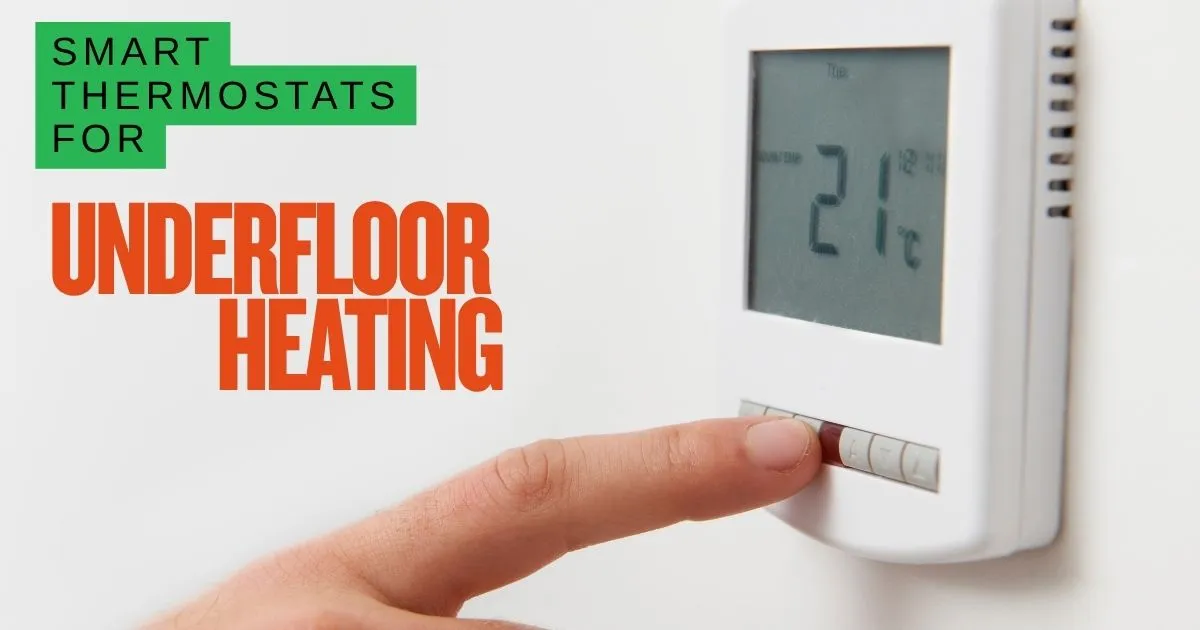
Quick answer: A manual thermostat is the cheapest option, but it gives you little control. A programmable thermostat is a sensible upgrade for a single, regularly used zone. For slower, multi-room underfloor heating, a room controller or hydronic control system usually makes more sense than a basic dial. Choose smart WiFi control when remote control, history and flexible schedules are worth the extra cost.
What makes an underfloor heating thermostat different?
Underfloor heating is not a small heater attached to a wall. The floor, screed or tile continues to release stored heat after the heating circuit has switched off. That means the best controller is not simply the one with the most features. It is the one that controls the correct equipment, measures the right temperature and is commissioned for the floor it serves.
There are six common choices:
- Manual thermostats use a dial or switch and need regular attention.
- Programmable thermostats run a fixed time schedule.
- Smart WiFi thermostats add an app, remote control and, usually, learning or optimisation.
- Room controllers combine room temperature control with schedules and multiple heating zones.
- Floor-sensing devices add a probe in the floor to protect the floor finish or control the surface temperature.
- Hydronic controls manage the boiler, manifold actuators, pump and room zones on a wet system.
These categories overlap. A smart thermostat can be a single-zone room controller, and a hydronic system may use floor sensors in every room. Think of them as features and system roles rather than separate products.
Manual thermostats: simple, but limited
A manual thermostat is the basic option. You set the temperature yourself and change it when your needs change. It normally switches the heating circuit on and off from the air temperature reading.
Accuracy and scheduling
The room-temperature accuracy is adequate for a simple installation, but accuracy depends heavily on sensor placement, the switching differential and the heating system. A manual control cannot automatically start early enough to compensate for a slow floor. If you switch it on at 7am, the room may be comfortable at 7am and still too cold at 8am.
There is no automatic schedule. A manual thermostat is most useful when the heating zone is used at predictable times and someone is available to change the setting.
Compatibility and installation
A basic manual unit may suit an electric mat or a simple hydronic zone, but only if its electrical rating, output type and sensor inputs match the system. An air-only thermostat should not be assumed to be suitable for electric UFH. Many electric-floor manufacturers require a floor sensor or a floor-limit function.
Installation is usually straightforward, but fixed electrical work still needs the correct protective device, conductor sizing and connection. See the UK underfloor heating wiring diagrams before replacing a controller.
Value
Manual controls have the lowest purchase price and fewest app-related distractions. Their value is limited by the need to adjust them yourself. For a rarely used bathroom or a simple single-zone installation, that can be acceptable.
Programmable thermostats: the practical middle ground
A programmable thermostat stores times and temperature settings for each day or part of the day. It is a better fit for a home with a regular routine because you can heat in the morning, lower the setting overnight and switch off when the property is empty.
Accuracy and scheduling
A programmable thermostat can control room temperature accurately enough for most residential UFH, provided it is installed away from sunlight, drafts and other heat sources. The key difference from a manual thermostat is not a more accurate sensor. It is automation.
The limitation is that a fixed schedule does not know that Friday is warmer, that you are working from home or that the floor takes two hours to respond. A basic programmer may also start heating at the same time every day, even when that is unnecessary.
Compatibility and installation
Programmable thermostats are available for electric and hydronic applications, but they are not interchangeable. Check whether the unit expects a switched live, a volt-free call, a floor sensor or a combination of these. A hydronic control also needs the right relay arrangement, while an electric controller must be rated for the mat or cable load.
Value
This is often the best value for one regularly used zone. You get a schedule without the cost, software updates and WiFi setup of a smart system. It is less flexible if your routine changes often, but it remains a sensible choice for a straightforward extension, bathroom or single-room conversion.
Smart WiFi thermostats: control without being in the room
A smart WiFi thermostat connects to your home network and usually links to a phone or tablet app. You can change settings, review heating history and adjust a schedule remotely. Some models also include learning, weather-based start, geofencing or open-window detection.
Our smart thermostat guide for UFH covers the features to look for in more detail. The Warmup 6iE review is a useful example of a smart controller designed around floor and room sensing, while the Smart Life app guide explains the setup and limits of app-based control.
Accuracy and scheduling
The air sensor still has to be installed in a sensible location. WiFi does not make a badly positioned sensor accurate. The real benefit is scheduling and control. A model that learns warm-up times can start earlier on a cold morning and stop earlier on a mild one, rather than treating every day as identical.
Remote control is useful if you arrive home late, have a holiday period or want to check whether the system has called for heat. It is less valuable if nobody needs that information and the fixed schedule already matches the household.
Compatibility
Check the thermostat against the actual heating load and system type. Many smart units are designed for a single electric zone, while a hydronic installation needs a call-for-heat output that can operate the manifold actuator or a wiring centre. The 6iE, for example, supports electric and hydronic arrangements, but its power, load and wiring requirements still have to be designed correctly.
App platforms also matter. A device may use the manufacturer's own app, Smart Life, Home Assistant, Apple Home or a specialist controller. The app name alone does not prove compatibility. Confirm the protocol, account requirement and local control options before buying.
Value and drawbacks
Smart controls are worth considering when a property has several routines, a holiday home or occupants who regularly arrive at different times. They cost more and need a stable 2.4GHz WiFi connection, accurate setup data and occasional attention to software and schedules. A failed internet connection should not leave a UFH system without a local means of control.
Room controllers: better decisions by room
A room controller is designed to control one room or zone, often with a weekly schedule, temperature set points and a floor limit. It may be wired to a hydronic manifold actuator, an electric floor circuit or a central wiring centre.
Accuracy and scheduling
The important improvement is not a bigger display. It is a clear relationship between the room sensor, the schedule and the heating output. A room controller can use separate comfort and set-back temperatures, hold periods and an optimum-start function. Those features are particularly useful for bedrooms, bathrooms and rooms that are only used at certain times.
A room controller may still be local only. If app control is important, check whether remote access is built in or supplied by a separate hub.
Compatibility and installation
A single room controller is straightforward. Multi-room systems are more involved. Each thermostat must be assigned to the correct manifold circuit, and the wiring centre must suit the actuators and heating source. The complete UFH zoning guide explains why one controller cannot safely operate unrelated zones.
Hard-wired room controllers usually need a back box, suitable cable routes and fixed connections. They are less flexible when a layout changes, but they tend to be more dependable than a cheap wireless system for a property that will be heated every day.
Value
Room controllers offer the best balance for a proper zoned installation. They give each room its own schedule and make use of hydronic zoning. The extra cost comes from the hardware, wiring and commissioning, not just the wall unit.
Floor-sensing devices: control and protection below the surface
A floor-sensing device is a probe installed within the floor build-up and connected to a controller. It measures the floor temperature and can be used as the control sensor or as a maximum-temperature limit.
Why floor sensing matters
The air sensor tells the controller what the room feels like. The floor sensor tells it what the floor surface is doing. For timber, laminate, vinyl and engineered wood, that second reading matters because the flooring manufacturer may set a maximum surface temperature. For an electric system, floor sensing can also help stop the circuit from overheating if the room's heat losses are unexpectedly low.
A dual-sensor controller may use the room sensor to determine comfort while using the floor probe to enforce a limit. The exact control method depends on the product. A floor sensor is not a substitute for correct pipe or mat design, and it cannot repair a badly positioned probe.
Accuracy and installation
Sensor accuracy is only useful if the probe is installed in the correct place within the floor construction. It should follow the manufacturer's instructions, usually between heating elements and not in an area that gives a misleading reading. Cable length, resistance and thermostat configuration must also match the manufacturer.
Value
Floor sensing is one of the most worthwhile features for a floor finish with a stated temperature limit. It costs more at installation, but it adds a direct safety and comfort function that an air-only thermostat cannot provide. For a wet system, a floor sensor can be useful where the floor needs tighter temperature management, although the design still needs to suit the pipe layout and floor finish.
Hydronic controls: the complete wet-system layer
Hydronic controls are not a room thermostat with a fancier screen. They coordinate the water-based UFH system. Depending on the design, they handle room thermostats, manifold actuators, the circulation pump and the call-for-heat signal to the boiler or heat pump.
Accuracy and scheduling
The control accuracy comes from the whole system design: sensor placement, actuator response, pump operation and the heating source. A hydronic controller can give each room a different schedule, but it cannot overcome an unbalanced manifold or circuits that are too long.
A good control system may use room demand, time schedules, frost protection and an outdoor-temperature compensation function. The last feature can help stabilise a wet system when conditions change, but it needs commissioning and the right outdoor sensor.
Compatibility and installation
This is the most important compatibility section of the comparison. A thermostat must match the voltage, switching method, actuator type and wiring arrangement. A 24V manifold with wireless or bus-connected room units is not the same as a 230V switched arrangement. Some controllers are designed to work with one manufacturer or one family of actuators only.
The underfloor heating wiring guide explains the basic control paths. The underfloor heating brand guide is also useful when comparing controllers alongside the wider system, but brand names do not remove the need to check the exact model and protocol.
Value
Hydronic controls justify their cost when a wet system serves several rooms or needs to integrate with a heat pump, boiler or building management system. A one-room wet loop may not need a sophisticated network. A basic local controller can be enough.
How to choose the right thermostat
Start with the system, not the feature list:
- Confirm electric or hydronic heating. Check the heating source, manifold, load and existing wiring.
- Count the zones. One room can use a simple programmable thermostat. Several rooms usually need separate room controls or a zoned system.
- Check the floor finish. If there is a surface-temperature limit, use a compatible floor-sensing controller.
- Decide how you will use it. A fixed schedule may be enough. Choose WiFi if remote access and changing routines matter.
- Check installation requirements. Make sure the back box, power, sensor cable, switching arrangement and protective device are suitable.
- Test the control plan. Enter accurate wattage, system type, room and floor details before relying on energy reports or learning features.
A thermostat cannot make a badly designed UFH system efficient. It can, however, help the system run at the right times, protect the floor and avoid unnecessary room-by-room heating.
Final verdict
Best value for a simple one-zone system: a properly installed programmable thermostat with a floor sensor where required.
Best for flexible routines and remote control: a smart WiFi thermostat designed for the load and heating type.
Best for several rooms: wired room controllers and a correctly designed zoning system.
Best for flooring with a maximum surface temperature: a controller using floor sensing as a limit or control sensor.
Best for wet UFH: a hydronic control system matched to the manifold actuators, pump and heat source.
The most important question is not “Which thermostat is smartest?” It is “Which thermostat controls this floor correctly?” Start with the system design, then choose the level of automation that saves you time without adding complexity you will not use.
Source notes
The comparison uses official manufacturer and government information for the technical features described above:
- Warmup 6iE official product information
- Ebeco EB-Therm 500 official product page
- Resideo T6 Pro Hydronic official product information
- UK Department for Energy Security and Net Zero: Explaining the most common heating controls
- Energy Saving Trust: thermostats and heating controls
One useful email,
once a month.
New guides as they go live. Real cost data, not press releases. The occasional rumour from the industry that's actually worth knowing.
No sales pitches. No jargon. Unsubscribe in one click.