Quick answer: On 26 August 2026, Ofgem confirmed the energy price cap will rise 4% from 1 October to 31 December 2026, reaching £1,723 a year for a typical dual-fuel household in England, Scotland and Wales. The increase falls almost entirely on gas, with unit rates up 8.7%, while electricity moves less than 1% because VAT on domestic electricity drops to zero from 1 October. For underfloor heating readers, this continues a trend seen across two consecutive caps. In both, electricity has risen far more slowly than gas, so the running-cost gap between the two fuels is narrowing. Details on the 0% VAT rate on domestic electricity.
This is the first cap period in which that zero VAT rate actually applies to bills.
The headline numbers
The cap applies to default and standard variable tariffs, not to fixed deals, and around 35% of households are currently fixed. For a typical capped household paying by direct debit, the level goes from £1,663 to £1,723 a year, up £60, or about £5 a month.
The unit rates matter more than the headline:
| 1 Jul – 30 Sep 2026 | 1 Oct – 31 Dec 2026 | Change | |
|---|---|---|---|
| Electricity | 26.11p/kWh | 26.32p/kWh | +0.8% |
| Electricity standing charge | 57.19p/day | 54.83p/day | −2.36p |
| Gas | 7.33p/kWh | 7.97p/kWh | +8.7% |
| Gas standing charge | 29.04p/day | 29.68p/day | +0.64p |
Gas figures for both periods include 5% VAT. The July electricity figure includes 5% VAT; the October one includes none, because the domestic electricity rate is zero from 1 October 2026 to 31 March 2027. Ofgem is explicit that this makes the two periods not directly comparable, and says the cap would have been roughly £45 higher without the VAT change.
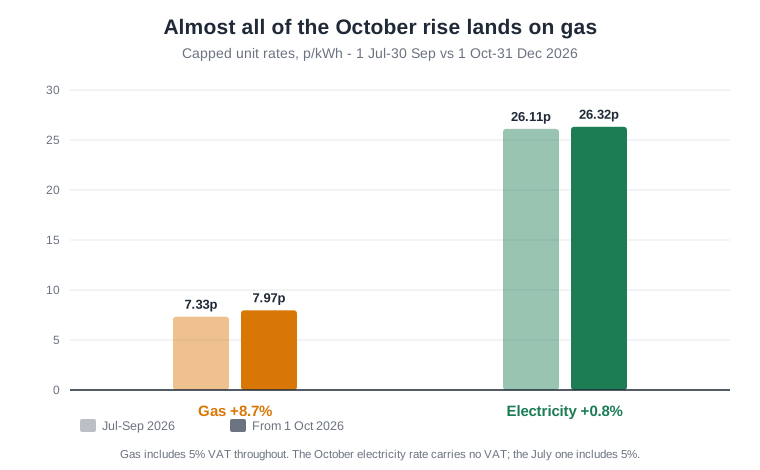
Ofgem attributes the underlying rise to higher wholesale gas prices linked to the ongoing conflict in the Middle East. Households with no gas supply at all will see an increase of under 1%.
If you are weighing a heat pump against a gas boiler on these numbers, the next step is comparing quotes from certified fitters who can model the real running costs for your property. You can find MCS-approved installers through underfloorheating.directory and request quotes from firms near you.
Why the "current cap" number may look wrong
If you followed the July 2026 price cap coverage, you will have seen £1,862 quoted as the current level. Ofgem is now quoting £1,663. Nothing has fallen. The measuring stick changed.
In July, Ofgem revised its Typical Domestic Consumption Values (TDCV), the assumed annual usage figures the headline number is built on. Households now use roughly 7% less electricity and 17% less gas than at the last review, so the assumed typical household is smaller. On the old 2023 TDCV, the same October cap would be quoted as £1,935, up from £1,862.
This is presentational, not a real saving. Your bill depends on your unit rates and your actual usage, not on Ofgem's assumed household. It does, however, nudge unit rates upward slightly, because suppliers recover fixed costs across fewer assumed units.
What it means for electric underfloor heating
Very little, in isolation. At 26.32p per kWh, a mat-based system in a bathroom using perhaps 300 kWh a year costs about £79 to run, up from £78. A larger installation using 1,200 kWh a year costs about £316, up from £313.
The more useful change is the standing charge, which falls by 2.36p a day. Sustained for a year that is about £8.60 off a capped direct debit electricity bill, whatever you use it for. For a modest electricity user it cancels out the unit-rate rise; for a heavily electrically heated home using 10,000 kWh a year it does not, because the extra 0.21p per kWh costs roughly £21 over the same period.

The practical advice is unchanged from our electric underfloor heating guide: direct electric heat costs what it costs at a given unit rate, so the levers are running less of it and paying less per kWh. If your controls are crude, getting the thermostat and scheduling right is usually worth more than a 0.8% rate move. Moving to a fixed or off-peak tariff can be worth more again, and Ofgem points households towards both.
What it means for wet systems and heat pumps
This is where the shift is more interesting.
The ratio between electricity and gas unit rates has moved from 3.56:1 in July to 3.30:1 from October. That ratio is the number that decides whether an electrically driven heat source beats a gas boiler on running cost.
Converted to pence per useful kWh of heat delivered:
- Gas boiler at 90% efficiency: about 8.9p per kWh of heat
- Heat pump at SCOP 3.5 (realistic with a well-designed underfloor circuit): about 7.5p per kWh
- Heat pump at SCOP 3.0: about 8.8p per kWh
- Heat pump at SCOP 2.8: about 9.4p per kWh
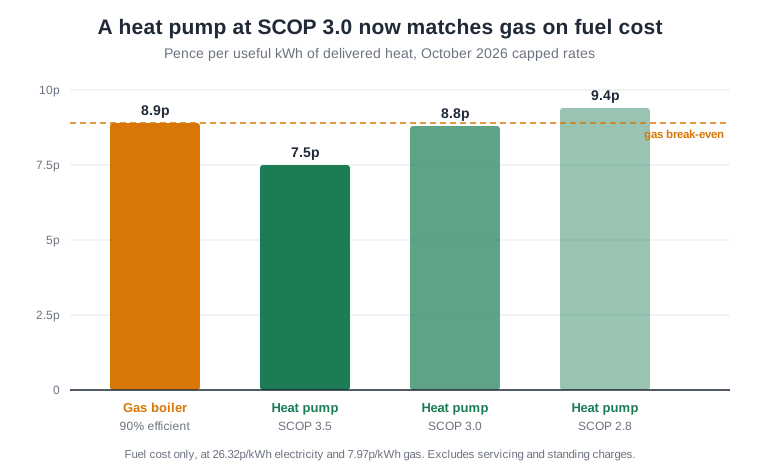
In other words, on energy cost per useful kWh alone, and against a gas boiler assumed to run at 90% efficiency, a heat pump feeding underfloor heating at a genuine seasonal efficiency of 3.0 or better is now level with or cheaper than gas under the October cap. Under the July cap it needed roughly 3.2. That comparison covers fuel only. It does not account for servicing, for consumption falling outside the SCOP boundary, or for the gas standing charge you keep or shed.
Two caveats are worth stating plainly. First, SCOP is not a guarantee. It depends on flow temperature, emitter sizing and controls, which is why a large low-temperature emitter surface matters. Underfloor heating provides that readily, though correctly sized low-temperature radiators can reach the same flow temperatures in the right house. Our heat pump and underfloor heating guide covers what actually determines the number in a real house. Second, this cap runs for three months, and the VAT relief is currently scheduled to end on 31 March 2027. A three-month crossover is not a permanent one.
Nobody should replace a working boiler on the strength of a quarterly price cap. But if you were already weighing a heat pump, for a renovation, an extension, or an ageing boiler, the arithmetic has moved slightly in its favour for the second cap running. Grant support through the Boiler Upgrade Scheme remains the larger factor in that decision, and if you are at the stage of gathering quotes, you can find MCS-certified fitters through the sister directory's MCS-approved installer listings.
What has not changed
- Wet versus electric. The comparison in our electric vs water underfloor heating guide is unaffected in structure. Wet systems are usually dearer to install and, given an efficient heat source, cheaper to run; electric usually makes sense for single rooms and for retrofits where running a wet circuit is impractical. Both depend on the heat source, the heat demand and the project.
- The fundamentals of cost control. Insulation, floor construction, flow temperature and run times still dominate. As set out in is underfloor heating expensive to run, a well-specified system in a poorly insulated house can easily cost more to run than an ordinary system in a well-insulated one, because insulation sets the heat demand the system has to meet.
- Regional variation. The figures above are national averages for direct debit customers on capped default tariffs. If you are on a fixed deal, none of these rates are yours until it ends. Standing charges in particular vary considerably by distribution region, and prepayment rates differ again.
The short version
A 4% cap rise that lands almost entirely on gas is not a crisis, and it is not a reason to change your heating system. It is, though, the second consecutive quarter in which electricity has risen far more slowly than gas. If that pattern continues past March 2027, when the VAT relief is due to expire, the long-standing assumption that gas is always the cheap option will need revisiting properly rather than quarter by quarter.
If this quarter has moved you from wondering to planning, the practical next step is a heat loss calculation and quotes from certified fitters who will model your own running costs rather than the national average. You can compare MCS-approved installers covering your area.
This story supersedes our coverage of the July 2026 price cap.
Sources: Ofgem: Energy price cap will rise by 4% from October 2026 · Ofgem: Energy price cap unit rates and standing charges · Ofgem: Changes to the energy price cap between 1 October and 31 December 2026