Quick answer: Commissioning is the final set of checks that proves an underfloor heating system is safe, full of water or correctly energised, and operating as designed. Electric systems need visual and electrical checks, correct thermostat and floor-sensor settings, then a controlled heat-up test. Wet systems need flushing, filling, pressure testing, bleeding, pump and controls checks, balancing and a heat-up test. The exact values come from the product instructions, system design and the relevant installer.
Commissioning is not a button you press once and forget. It's a process that catches trapped air, poor pump settings, unbalanced loops, a loose sensor, an incorrectly set thermostat and electrical faults before the floor is covered or the client starts using the system.
This guide covers the handover stage for both electric and wet UFH. It sits alongside the full underfloor heating installation guide, manifold guide and DIY or professional installation guide.
What should commissioning prove?
At the end of commissioning, you should be able to show that:
- the installation is complete, clean and physically secure;
- the electrical or plumbing connections are safe and correctly protected;
- the system contains no trapped air or unwanted debris;
- the pump, actuators, thermostats and sensors operate correctly;
- each zone produces the intended flow or heat;
- the floor warms evenly and the control switches it on and off at the right point;
- the client knows how to operate the system and where the records are.
Do not raise electric heat, energise a wet heating circuit or run a boiler or heat pump simply to prove it works. The heat source, electrical supply, pressure limits and tests must be approved by the relevant competent person or installer.
Before you start: gather the documents
Commissioning is much easier when the design information is to hand. Ask for the system design, circuit list, pipe or mat schedule, electrical design, manufacturer instructions and target flow rates. Have the floor finish, adhesive and screed data available too.
For wet UFH, record the:
- heat source and target flow temperature;
- working pressure and test pressure;
- each zone's length, pipe size and target flow in litres per minute;
- pump curve or pump setting;
- actuator and thermostat type;
- inhibitor or water treatment used;
- screed cure and first heat-up instructions.
For electric UFH, record the:
- mat or cable model, wattage and supply voltage;
- thermostat model and electrical rating;
- floor sensor resistance and position;
- floor finish and adhesive temperature limits;
- circuit and protective-device details;
- intended schedule, floor limit and switch differential.
If the documentation is missing, stop and get it resolved. A guessed temperature limit or flow rate can damage the floor or make the system impossible to balance.
The initial visual inspection
Start with the system isolated, following the manufacturer's lock-off procedure. Look for damage, contamination, incorrect fixing and unfinished connections.
Electric system checks
Check that the mat or cable is fully secured, with no cuts, kinks, crossed cables or damage from subsequent trades. The visible supply leads should be protected and routed so they cannot be cut by a floor finish or damaged by a later builder.
Confirm that the thermostat is suitable for the load. A controller rated below the mat's wattage is not suitable. Check the floor sensor is correctly positioned between heating elements, not on a cable or at the edge of the heated area. The sensor must not cross a mat cable.
Check the bonding arrangements required by the electrical design. In England, fixed electric floor heating in a dwelling falls within the scope of the Building Regulations' electrical safety requirements. See GOV.UK Approved Document P. The final connection, protective device and electrical testing should be carried out by a competent person using the design and the current edition of BS 7671.
Wet system checks
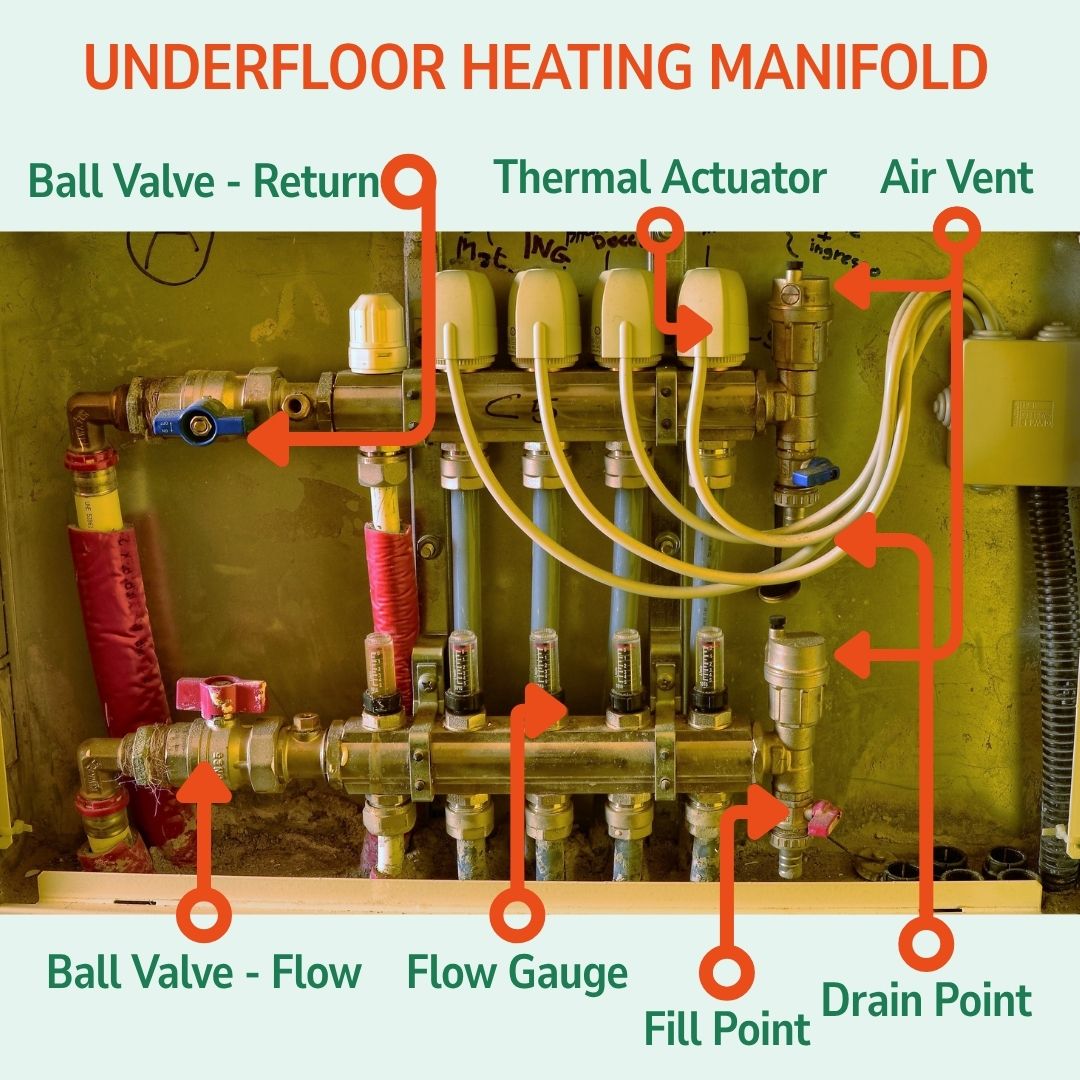
Check pipework for kinks, crushing, open ends and accidental damage. Confirm the manifold, pump, valves, actuators, sensors and air vents are installed as designed. Check that isolation valves can be reached and that the boiler or heat pump connection is safe.
Look for leaks at joints and around the pump and manifold. Do not pressure-test a system with a heat source that has not been isolated or approved for the test. The pressure test should follow the pipe manufacturer's instructions and the design pressure. A typical domestic UFH circuit may be tested and operated at a few bar, but the correct value is not universal.
Do not use an arbitrary bicycle pump or garden hose as a substitute for a proper test arrangement. A low-pressure manual test may not reveal a weakness that appears at working pressure.
Electric UFH: electrical tests and first heat
For electric UFH, a qualified electrician should carry out the fixed wiring inspection and tests. Testing usually includes verification of continuity, insulation resistance, polarity, earth continuity where applicable, fault protection and the operation of the controller. The exact test values and methods must follow the electrical design and BS 7671, not a generic internet checklist.
A resistance measurement of the heating element can be useful as a product or installation check, but it is not a substitute for the required electrical safety tests. Compare the measured resistance with the manufacturer's expected value, accounting for the supplied voltage and element wattage. A reading of open circuit, a short circuit or a value that changes substantially needs investigation. Do not energise a damaged mat.
Before energising, confirm the floor finish and adhesive have cured. Set the thermostat to a moderate target rather than maximum output, then increase it in stages while monitoring the floor. The first heat-up should be slow enough to allow moisture to leave the floor build-up without stressing joints, adhesive or timber.
Check the floor sensor response by warming it gently and confirming the controller follows its configured floor-limit function. Do not test the sensor with an open flame or excessive heat. The correct resistance and wiring diagram come from the thermostat and sensor instructions.
Record the time taken for the floor surface to reach a comfortable temperature. If the mat is energised before the screed or adhesive has cured, the warranty or floor finish may be affected. Follow the specific manufacturer's cure and commissioning schedule.
Wet UFH: flush, fill and bleed
A wet system is commissioned with clean water and the correct pump and valves open. Before filling, confirm the design flow and return temperatures, the blend valve or heat-pump settings, and the boiler or heat pump is ready to supply heat.
Flush the circuit as required by the pipe and manifold manufacturers. Some systems are supplied pre-cleaned and do not need a full chemical flush. Others require a flushing regime to remove installation debris, flux or contamination. Use only the approved cleaning product, dose and disposal method. Do not pour aggressive chemicals into a system connected to a boiler, heat pump or domestic water equipment without checking compatibility.
After flushing, drain or clear the flush equipment as instructed, close the relevant valves, remove airlocks and refill slowly. Work through each zone and bleed until water flows smoothly. The manifold's automatic air vent should be fitted and functioning, but it does not replace correct bleeding of every circuit.
A good wet UFH commissioning record should include the initial system pressure, the test pressure, hold time, pressure after isolation, and the final operating pressure. If pressure falls during a proper hold test, find and repair the leak before filling the floor permanently.
Pressure testing a wet circuit
Pressure testing is for wet systems only. Electric UFH has no water circuit, so a pressure test is not applicable. For a wet circuit, confirm the pipe, manifold and heat source manufacturer's pressure limits, then use suitable test equipment and a gauge you can read accurately.
A sensible process is:
- Isolate the heat source and any parts that must not be exposed to the test pressure.
- Fill and bleed the circuit, including the manifold and pump.
- Raise the pressure to the specified test pressure, never exceeding the weakest component's limit.
- Hold it for the time stated in the design or instructions.
- Isolate the pump if required by the instructions and check for pressure loss.
- Inspect every joint, valve, pump and connection.
- Return the system to its normal valve configuration and operating pressure.
Do not use bubbles or silence to decide whether a pressure test passed. A gauge, a timed hold and a recorded result are more useful evidence.
Pump, controls and thermostat setup
Check the pump rotates, is correctly wired and is set to the design speed or duty. If the pump has a speed selector, the manufacturer's setting range and the system's pressure loss must be considered. Never override a pump or control setting simply to make one room warm.
Open each thermostat and zone valve in turn. Confirm the actuator opens the correct circuit, the pump starts when a zone calls for heat, and the actuator closes when the call is removed. Test the schedule, frost protection or setback mode and the boiler or heat-pump enable signal.
Set the thermostat away from direct sun, drafts, radiators, fireplaces and doorways. For a floor-sensing controller, check the floor limit against the floor finish and manufacturer instructions. Don't set a high floor limit simply to make a cold room reach the thermostat temperature quickly. That can overheat the floor and damage the finish.
Our thermostat comparison explains the difference between air, room and floor control.
Floor sensors, heat-up curves and balancing
A floor sensor is not an extra luxury. It is often essential for limiting floor temperature, protecting a sensitive finish and managing the slow response of a screed or concrete floor.
For a wet system, run a commissioning heat-up curve after balancing. Record the time, supply and return temperatures, and surface or floor temperatures at sensible intervals. A typical first heat-up may take several hours, but the design, insulation, floor mass, flow temperature and weather all affect the result. Don't copy a generic graph. Use it to create a useful start time for each room.
The US Department of Energy's building commissioning guidance explains the wider principle of checking that systems operate as intended. For UFH, that means verifying the whole system rather than only confirming that the manifold feels warm.
Balance the wet system to the designed flow rates, starting with the longest loops. Recheck all zones after each adjustment and repeat the process. See how to balance and bleed a manifold for the practical process. The annual maintenance checklist is useful after handover too.
Common commissioning mistakes
The most common failures are straightforward:
- energising an electric floor before the adhesive or screed is ready;
- using a thermostat or sensor that isn't suitable for the floor;
- failing to test the floor sensor and floor limit;
- running the pump at full speed without checking the design;
- leaving air in one long circuit;
- pressure-testing a wet system above the rating of a component;
- skipping the post-test leak inspection;
- balancing only once instead of repeating the adjustments;
- copying a heat-up time from another floor build-up;
- failing to give the client the records or emergency isolation instructions.
Handover
Handover is the final part of commissioning. Explain the controls, isolation points, frost protection, schedules, floor limitations and what to do if a zone stays cold or the floor becomes unexpectedly hot.
Leave a written record with the system layout, circuit list, electrical and pressure test results, flush and inhibitor information, final flow settings, thermostat settings, sensor settings, heat-up times, control schedules, contact details and warranty requirements. Store it with the building handover pack and take a copy for the installer.
If a system is not fully commissioned, make the limitation obvious. It is better to record a remaining action than to hand over a system that appears complete but has not been tested.
Safety boundary: Commissioning does not replace a competent design, installation, pressure test or electrical certification. Keep the system isolated while inspecting or working on it, follow the product instructions, and stop if a pressure, temperature or electrical reading exceeds the manufacturer's limits. For electrical work, use a competent electrician. For gas, boiler or heat-pump connections, use an appropriately registered and qualified installer.
Official references and further reading
For UK electrical requirements, start with GOV.UK Approved Document P: electrical safety, dwellings. For general electrical safety and maintenance principles, see the Health and Safety Executive's electrical safety guidance.
For a second set of eyes, find a local UFH specialist through the Underfloor Heating Directory, or compare electric and wet installation options before booking work.
One useful email,
once a month.
New guides as they go live. Real cost data, not press releases. The occasional rumour from the industry that's actually worth knowing.
No sales pitches. No jargon. Unsubscribe in one click.