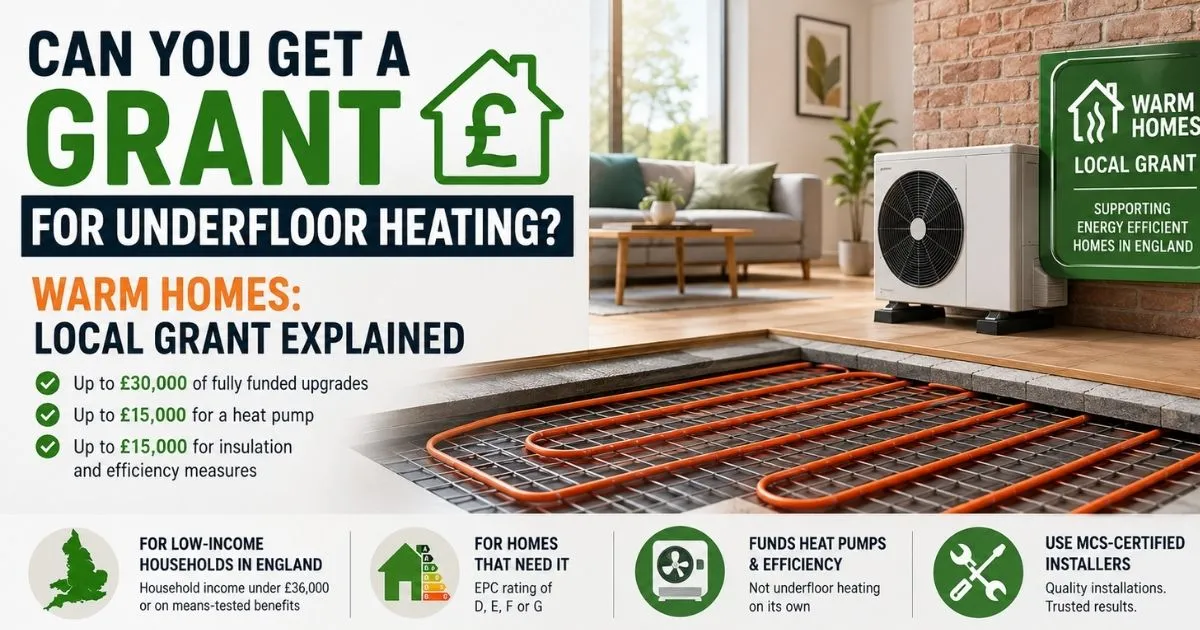
Quick Answer: The Warm Homes: Local Grant offers eligible low-income households in England up to £30,000 of fully funded home upgrades — up to £15,000 for a heat pump and up to £15,000 for insulation and other efficiency measures. It does not pay for underfloor heating on its own. But because it funds the heat pump that underfloor heating pairs with best, it is well worth understanding if you are planning a wider heating upgrade. To qualify you generally need a household income under £36,000 (or to be on means-tested benefits), to own or privately rent your home, and to have an EPC rating of D, E, F or G.
Can you get a grant for underfloor heating?
Not directly — and it is worth being clear about that up front, because a lot of coverage blurs it. No current UK government scheme writes you a cheque specifically to install underfloor heating. What the schemes fund is low-carbon heating (overwhelmingly heat pumps) and energy-efficiency measures (insulation, draught-proofing, glazing, sometimes solar).
The reason underfloor heating still matters here is simple: a heat pump runs at its best with a large, low-temperature emitter, and that is exactly what underfloor heating provides. So if a grant is paying for your heat pump, underfloor heating is often the ideal way to deliver that heat — even if the floor system itself sits outside the grant.
What is the Warm Homes: Local Grant?
The Warm Homes: Local Grant is part of the government’s wider Warm Homes Plan. It runs from 2025 to 2028 and is delivered through individual local councils rather than applied for centrally. It is aimed at low-income households living in the least energy-efficient privately owned homes in England.
The scheme launched in June 2025 and proved extremely popular: many council portals temporarily closed to new applications late in 2025 while they worked through the backlog, with most reopening through spring 2026. Availability and exact rules therefore vary by council, so your local authority’s page is always the definitive source.
How much you can get
The headline figure is up to £30,000 per property, split into two pots:
- Up to £15,000 for low-carbon heating — in practice, an air source heat pump.
- Up to £15,000 for energy-performance measures — insulation, draught-proofing, double glazing and, in some cases, solar panels.
For most households the upgrades are fully funded, with no contribution required. The grant is separate from the Boiler Upgrade Scheme, which offers £7,500 towards a heat pump for able-to-pay households and is not income-restricted — so if you do not qualify for Warm Homes, that may be the route to look at instead.
Who qualifies
Eligibility is set nationally but assessed by your council. As a general guide, you should be eligible if:
- Your household income is under £36,000 a year, or you receive means-tested benefits. Some councils will still consider you above that figure if your housing costs are high.
- You live in a privately owned home — either as the owner-occupier, or as a private tenant whose landlord agrees to the work.
- Your home has an EPC rating of D, E, F or G (the less efficient bands).
- You are resident in England. Scotland (Warmer Homes Scotland), Wales (the Optimised Retrofit Programme) and Northern Ireland (the Affordable Warmth Scheme) run their own equivalents.
Where underfloor heating fits in
If you are moving to a heat pump — grant-funded or not — the emitters matter enormously. Heat pumps are most efficient when they deliver warmth at low flow temperatures, and wet underfloor heating is the lowest-temperature emitter you can fit. That is why the two are so often specified together, and why a heat-pump grant can be the moment it makes sense to think about your floors.
A few practical points worth knowing:
- Underfloor heating usually is not a grant-funded measure, so if you want it you will typically pay for it yourself alongside the funded heat pump and insulation.
- It can lower your running costs. Pairing a heat pump with underfloor heating keeps flow temperatures down, which is exactly where heat pump efficiency — and your day-to-day running costs — improve.
- Retrofit is possible but needs planning, especially around floor build-up and insulation. If you are weighing it against keeping radiators, our wet versus electric comparison and our guide to whether underfloor heating is worth it are good starting points.
It is also worth checking how any work fits with the UK building regulations for underfloor heating, which set efficiency and zoning expectations for new installations.
How to apply and what to check
Because the Warm Homes: Local Grant is run locally, you apply through your own council, not a national portal. Search your council’s website for “Warm Homes: Local Grant”, check whether its portal is currently open, and confirm the income and EPC criteria it is applying.
Whether you go through this grant or pay privately, any heat pump work should be carried out by an MCS-certified installer — it is a condition of the grant funding and your protection on quality. You can find vetted specialists in our sister directory of MCS-approved underfloor heating and heat pump installers.
The bottom line
The Warm Homes: Local Grant is a genuinely substantial offer — up to £30,000 for eligible English households — but it is a heat-pump-and-insulation scheme, not an underfloor heating grant. If you qualify and you are switching to a heat pump, that is precisely the point at which underfloor heating becomes worth costing in, because it lets the heat pump run efficiently and keeps your bills down. Treat the grant as the trigger for a sensible whole-system upgrade, check your council’s current rules, and use an MCS-certified installer for the heat pump itself.
About the author
Damian Krzyzanowski is an underfloor heating content specialist and the founder of Underfloor Heating Hub. He focuses on turning installer, manufacturer and system-design experience into clear, jargon-free guidance for UK homeowners — from running costs and system choice to grants and regulation. Connect with him on LinkedIn.
This article is a general explainer, not financial advice; eligibility and amounts vary by council and may change. Check your local authority for current rules. Last reviewed 15 June 2026.
Sources: Warm Homes: Local Grant – guidance for local authorities (GOV.UK); Warm Homes: Local Grant Policy Guidance (GOV.UK PDF); MoneySavingExpert – Warm Homes: Local Grant; Uswitch – Warm Homes: Local Grant scheme.