
Quick answer: Water underfloor heating is not limited to gas boilers. It can work with a combi boiler, a system boiler, an oil boiler, a biomass boiler or a heat pump. The important question is whether the heat source can deliver the design flow temperature, control it to suit the floor and provide the flow rate needed by the manifold pump. A replacement boiler is not automatically necessary, but an existing UFH circuit should be checked before any boiler change.
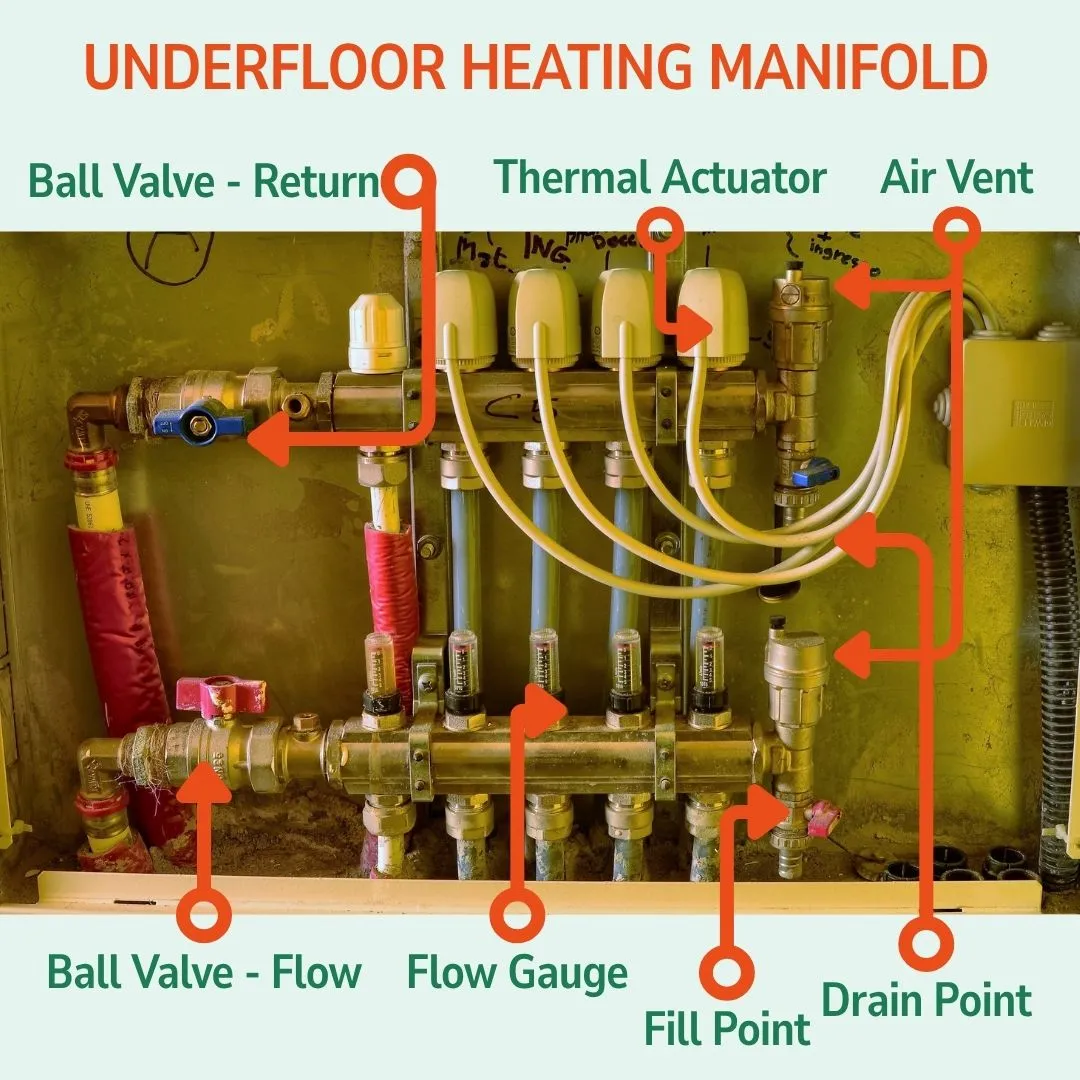
A wet underfloor heating system is a low-temperature emitter. Water travels through pipes in the floor and releases heat across a large surface area. That makes the floor suitable for a heat pump, but it does not mean every boiler can be connected in exactly the same way.
The boiler, heat pump, pipework and controls have to work as one system. A floor can be physically sound and still fail to heat properly if the water is too hot, too cold, circulating at the wrong rate or constantly switching on and off.
What does boiler compatibility mean?
Compatibility is not a yes or no test. It is a set of questions:
- Can the heat source reach the flow temperature designed for the floor?
- Can it modulate down to that temperature?
- Does the system need a buffer vessel or hydraulic separation?
- Is the boiler or heat pump able to control the UFH pump and zone valves?
- Is the heat source large enough for the calculated heat loss, without being so oversized that it short-cycles?
- Can the installer commission and record the complete system?
The floor construction matters too. A well-insulated screed floor can often be designed around lower temperatures. A poorly insulated floor, heavy floor finish or exposed pipe circuit may need a higher design temperature. The CIBSE underfloor heating design and installation guide covers heat-loss calculations, design flow and return temperatures, controls and commissioning.
Flow temperature is the starting point
Flow temperature is the temperature of the water leaving the heat source and entering the UFH circuit. Return temperature is what comes back after the floor has absorbed heat. A typical water UFH design may use a flow around 35°C to 45°C, but the correct figure depends on the heat loss, pipe layout, floor insulation, floor finish and design output.
Do not treat 35°C to 45°C as a universal setting. It is a useful design range, not a rule that works in every home. A higher target may be needed where heat loss is high or the floor has less effective insulation. The design should establish the maximum flow temperature at the coldest design conditions, not simply copy a generic boiler setting.
The Energy Saving Trust explains that wet UFH uses a large surface area and can work with a boiler or heat pump at lower flow temperatures. The exact temperature and output still need to be calculated for the property. GOV.UK research on heat pump heating methods also makes the point that the lowest flow temperature that meets the building's demand is preferable for heat pump efficiency.
Combi boiler compatibility
A combi boiler can be used with water UFH where the boiler's heating output, modulation, controls and hydraulic arrangement suit the design. It is not necessary to fit a combi boiler that is sold as specially for UFH. The floor circuit still needs the right flow temperature, pump, manifold and control arrangement.
There are three common connection arrangements:
- Weather compensation or a boiler-side control reduces the boiler flow as outdoor conditions change.
- A manifold mixing valve blends the hot primary flow with the cooler UFH return to produce the target flow temperature.
- A low-loss header or buffer vessel can hydraulically separate the boiler and UFH circuits, with the circulation pump and controls arranged to suit.
A combi boiler is most straightforward when the property already has a suitable heating circuit, the boiler can modulate sufficiently and the installer can provide a dedicated UFH pump and zone control. A combi that cannot deliver a stable low flow, or a circuit that repeatedly calls for hot water, may make the floor less efficient or less responsive.
System boiler compatibility
A system boiler with a separate hot water cylinder often gives more flexibility than a combi. The boiler and cylinder have separate demands, so the heating flow can be controlled for the UFH without being tied to every hot water draw.
A system boiler can be a sensible choice for a property with a stored hot water cylinder and several UFH zones. Ask the installer to confirm the boiler's minimum modulation, maximum and minimum flow rates, and whether weather compensation is available.
Oil boiler compatibility
Oil boilers can feed water UFH. The same temperature and hydraulic rules apply as for a gas boiler. In practice, the oil system may use a buffer vessel, a primary pump and a separate UFH pump to separate the boiler circuit from the floor circuit.
The oil boiler's output, modulation range, flow temperature and minimum flow requirements must match the UFH design. Do not assume that any oil boiler is compatible because it can heat radiators. A boiler that is oversized for a low-temperature floor may cycle frequently if the controls are poorly set.
An oil-fed UFH system can work where a property is off the gas network and the floor is designed for low-temperature water. It still depends on a fossil fuel supply, so the running-cost and future replacement decision should be considered separately.
Biomass boiler compatibility
Biomass boilers can also supply water UFH, but compatibility needs more attention. Fuel type, boiler output, modulation, ash handling, water treatment, storage and the heating strategy all affect the installation.
A biomass boiler may produce higher water temperatures for hot water or radiator circuits. A UFH circuit may still need a lower flow, so the system can require mixing, buffering and a carefully designed control sequence. Some installations use the boiler as an intermittent or backup heat source, while a low-temperature source handles the baseload.
The GOV.UK Approved Document L includes system-specific guidance for solid fuel heating and underfloor heating. It is building-regulation guidance, not a boiler selection manual, but it is useful background when a solid fuel system forms part of a new or substantially altered heating installation. The boiler manufacturer's current installation instructions remain the controlling document for that product.
Gas boilers and flow temperature
A gas combi or system boiler is a common heat source for wet UFH. The gas itself does not determine the floor temperature. The heat exchanger, burner, weather compensation, controls and hydraulic design determine what the boiler can deliver to the floor circuit.
A traditional radiator circuit may be designed for much higher temperatures than UFH. Connecting that boiler directly to the floor without the correct controls could expose the screed, pipe and floor finish to a temperature they were not designed for. Conversely, lowering the boiler temperature too far may leave the floor short of heat on the coldest days.
The right answer is a design calculation and a commissioning record, not a fixed boiler setting. A replacement boiler should be selected for the property's heat loss, DHW needs, available fuel, controls and required flow temperature. It should not be chosen only because it is a popular model or because a fitter says UFH is easy to connect.
Heat pump compatibility
Heat pumps are usually a strong match for water UFH because both can work at relatively low water temperatures. The underfloor heating with heat pumps guide explains the design, flow-temperature and running-cost considerations in more detail.
The heat pump still has to meet the heat loss at its selected flow temperature. A heat pump selected for radiators at 60°C or above may run less efficiently with a low-temperature floor if the design flow is too high, although the floor itself is not the problem. The heat source, floor and controls need to be designed together.
A weather-compensated heat pump can lower the flow when the property needs less heat. Buffering may help with minimum flow requirements, cycling or hydraulic separation, but adding a large buffer is not a universal remedy. It can increase storage losses and slow the system's response. GOV.UK research notes that a buffer can reduce rapid cycling and provide a minimum flow, while a series buffer in the return can help protect the heat pump's response time.
Buffer vessels and primary circuits
A buffer vessel is a stored volume of water that separates heat production from heat demand. It can help a boiler or heat pump maintain a suitable flow, reduce short cycling and provide a reserve of heat. It may be needed for a low-volume heating circuit, a particular heat source or a combined boiler and heat-pump arrangement.
A buffer is not a substitute for a correctly sized pump, expansion vessel, pressure control, air vent, mixing valve or heat-loss calculation. It is also not always necessary for a straightforward boiler-fed UFH installation. The design should state what the buffer is intended to do and how the primary circuit is arranged.
In a two-pipe primary circuit, hot water from the heat source passes through the buffer or header and returns separately. In some systems, an inline or return-pipe arrangement may be used. The connection and pump positions must follow the heat source manufacturer's instructions and the hydraulic design.
Controls that make the system work
The controls should give the floor a demand signal and the heat source a safe, stable operating point. A typical arrangement may include:
- room thermostats or temperature sensors for each UFH zone;
- manifold actuators that open the relevant zone;
- a UFH pump that runs only when a zone has demand;
- an outdoor sensor for weather compensation;
- a boiler or heat pump controller that receives the heating demand;
- a mixing valve or buffer where the design requires one;
- a floor sensor where a floor temperature limit is needed.
The hybrid arrangement is covered in the hybrid underfloor heating guide. It explains why a boiler and heat pump need deliberate sequencing if both are connected to the same UFH circuits.
Boiler sizing
Size the heat source from the property's calculated design heat loss, then check that the selected appliance can deliver the required output at the required flow temperature. The appliance's nominal output is not enough on its own. Output falls or changes as the flow temperature changes, and part-load operation matters.
An oversized boiler may have enough peak output but may cycle inefficiently when the building needs only a small amount of heat. An undersized appliance may fail to meet the design conditions even though it is adequate on a mild day. The designer should also account for domestic hot water, pipe heat-up, zoning and the heat source's modulation range.
A replacement boiler is usually justified when the existing appliance is faulty, at the end of its useful life, unable to meet the required flow or output, or incompatible with the planned controls and future heat source. A functioning boiler is not automatically unsuitable for UFH just because it also serves radiators or a hot water cylinder. It may be worth replacing when a heat pump upgrade is being designed, but that is a whole-system decision.
Commissioning proves compatibility
Before the floor is covered or the system is handed over, the installer should test the complete arrangement. This includes checking:
- the heat source output and flow temperature;
- UFH pump operation and flow rate;
- manifold valve and actuator operation;
- thermostatic controls and any mixing valve;
- system pressure, expansion and air removal;
- zone-by-zone flow and return temperatures;
- the heat-up response and floor temperature;
- the recorded settings for normal use.
A UFH circuit that has not been balanced may be electrically and hydraulically connected but still produce uneven floors. Follow the underfloor heating commissioning guide for the handover process, and the water UFH guide for the pipe and manifold basics.
When a replacement boiler is needed
Ask for a replacement boiler only after a survey has established why the existing heat source cannot meet the design. Common reasons include insufficient output at the required flow temperature, no suitable modulation, unreliable controls, an open or undersized primary circuit, a failed heat exchanger, or a planned move to a heat pump or other low-temperature system.
Do not replace a working boiler solely because the house has UFH. Do connect UFH only through a designed control and hydraulic arrangement. The installer should provide the design flow and return temperatures, pump settings, control schedule, commissioning results and operating instructions.
Sources and further reading
- CIBSE: Underfloor heating design and installation guide
- Energy Saving Trust: Underfloor heating
- GOV.UK: Approved Document L guidance
- GOV.UK: Investigation into buffer tanks and heat pumps
- GOV.UK: Heat pump methodology and flow temperatures
The practical rule is simple. Let the building's heat loss and floor construction set the design temperature, then choose a heat source and controls that can deliver it reliably. Wet UFH is compatible with many boilers and heat pumps, but only a properly designed system is genuinely compatible.
One useful email,
once a month.
New guides as they go live. Real cost data, not press releases. The occasional rumour from the industry that's actually worth knowing.
No sales pitches. No jargon. Unsubscribe in one click.